The honest answer in 30 seconds
Race the split you have logged through the body of an actual training piece, not the split that flashed on the screen at the 250m mark of a relaxed warm-up Wednesday at Don RC. The pattern that holds across OUA trial weeks, CSSRA Championship heats and Royal Canadian Henley selection sets is the J-pattern. Five hard strokes, a 10-15 stroke flyer at roughly 3-4 seconds under target, settle by the 250m line, ride flat through 1500m, then 30 strokes of build into a sprint. Most blown 2ks in Canadian programmes trace back to one decision: pulling the first 500 four seconds too quick. Anchor a target through the 2k prediction calculator, sanity-check the wattage with the watts-to-split converter, and run the piece under a published protocol if the number has to count for selection.
Every rower at Brock, Western, Trent, McGill or Queen's has the same story. The opening 1000 feels controlled, the Concept2 PM5 reads exactly where you wanted, then somewhere past 1200m the wheels detach. The fix is rarely fitness. The fix is pacing. What follows covers the four split shapes coaches in Canadian boathouses recognise on sight, the target-split maths that prevents the 1500m crater, the protocol notes that matter if RCA selectors or an OUA varsity coach are reading the number, and the mental cues that hold when the rational brain has clocked off. Use it whether you are building toward Canadian Indoor Rowing Championships in February, a fall OUA trial block, a CSSRA Championship 1st VIII seat, or just a club benchmark before the ice melts off Henley Island. Pair it with the guide to the four ergo metrics worth tracking for the season-long picture.
Why pacing wins or loses a 2k
A 2k lives in the worst part of the physiological map. Too long to bash through on power alone. Too short to hide behind aerobic base. Roughly 70-80% of the work pulls from the aerobic system, 20-30% from anaerobic glycolysis, and that mix is unforgiving. Open hot and lactate stacks up faster than the aerobic system clears it. The wall arrives between 1200m and 1500m, and the final 500 turns into damage limitation rather than racing. Open soft and the piece ends with fuel unused, which is a polite way of saying the score is slow.
The strongest aerobic engine in any Canadian squad still cracks if the pacing decision is wrong. Coaches at the Argonaut Rowing Club, Leander Boat Club Hamilton or Brentwood College School deliver the same lesson on repeat: the 2k pays out for discipline, not courage. A controlled first 500m predicts whether the second 1k is racing or surviving more reliably than any single ergometric variable. Holding shape when the monitor is offering you two free seconds you cannot actually afford - that is where personal bests come from.
The four 2k pacing profiles
Watch enough 2k pieces play out on the PM5 split-per-500 view and four shapes keep appearing. The Concept2 ErgData app and the online Logbook both render them clearly. Coaches at clubs from Hudson Boatworks demo events through to Don RC winter testing nights spot the patterns in seconds. Three of the shapes lose time. One produces personal bests.
The four shapes of a 2k erg piece
Positive split - the blow-up
First 500m is the fastest, every subsequent quarter is slower. Feels brilliant for three minutes, brutal from 1200m. The single most common error at every level from CSSRA novice trials to RCA development camp testing. Costs more personal bests than every other mistake combined. Avoid.
Flat split - the metronome
All four 500m splits within roughly half a second. Predictable, repeatable, honest. The right call for a rower pulling a first 2k of the season, or for a club benchmark sandwiched between two heavy training weeks. It will not turn into a personal best but it will produce a clean number you can compare against the rest of your year.
Negative split - the back-end push
Second 1k quicker than the first. Lactate-friendly and physiologically efficient, but it concedes time in the opening 500 that you can never get back. NCCP-trained coaches often prescribe this for athletes returning from injury or for the first benchmark of a fall trial block, where consistency matters more than chasing a ceiling.
J-pattern - the racing shape
Quick first 500 from a controlled flyer (about 1-2 seconds under target), middle 1k riding the target line, then a built final 500 with a 30-stroke sprint to the screen. The pattern under almost every meaningful PB at Canadian Henley qualifying, OUA Championship trials or the Canadian Indoor Rowing Championships in Hamilton.
The J-pattern works because the opening seconds cost almost nothing physiologically while buying a real mental cushion later. The held middle 1k protects the system from a lactate flood that would make any sprint impossible. The back-half build then spends aerobic and alactic capacity you have been guarding. Most NCCP-pathway coaches will let a junior or first-year university athlete race a flat split for the opening one or two tests of the season, then move them to the J-pattern once they have the feel of the piece in their hands.
Elite male rowers in our analysis adopted a fast-start, even-pace strategy in the 2,000m on-water race, with the first 500m the fastest section and the middle 1,000m held at a remarkably even pace - a pattern that maximises performance under the energetic demands of the event.
Step-by-step: first 500, middle 1k, final 500
Treat a good 2k as three separate efforts welded together. Start. Body. Sprint. Each one gets a split target, a rate target, and a feel cue you can write on a piece of masking tape and stick to the monitor.
First 500m - controlled flyer, then settle
Five hard strokes at rate 42-44 to wake the flywheel. Ten to fifteen power strokes that follow at rate 36-38, sitting roughly 4-5 seconds under target split. By stroke 30 the rate is at base (typically 32-34 for senior men, 30-32 for senior women, juniors and masters athletes usually about two beats lower across the board) and the split is sitting 1-2 seconds under target. If the monitor reads 4 seconds under target at the 250m line you have made the most expensive mistake available. Settle right now. The back half will punish anything else.
Middle 1000m - hold the boring line
From 500m through 1500m the assignment is dull. Hold target split. Hold base rate. Nothing more. A voice arrives somewhere around 700m offering ten free strokes worth of extra effort. Ignore it. That voice goes quiet around 1000m when lactate bites and the piece slides into what NCCP coaches sometimes call the long room. The only correct move is to ride the target line and let the rate carry the watts. Pulling harder for ten strokes to see what is in there robs from the 500m to 250m build you are about to need.
Final 500m - 30 strokes to the line
At 500m to go the rate climbs two beats (commonly to 34-36 for the sustained build). Bring the split down by 1-2 seconds and accept that the next 90 seconds are about to feel meaningfully worse than everything that came before. At 250m to go, sprint. Rate climbs to 38-42. Drive everything through the foot stretcher. Pull the split as low as it will move. The last 20 strokes look ugly on video and that is fine. Cross the line. Stop the machine. Breathe.
Worked example: an honest 7:00 2k via the J-pattern
Target split 1:45.0. Rate plan 36-32-32-34-38-42 across the start, body, build and sprint.
Flyer settles to base
Held at target
The long room
Build, then sprint
How to set your target split
A defensible target is a split you have evidence to back. Anything else is a wish dressed up as a number. Four ways Canadian coaches anchor a 2k target ahead of an OUA trial, a CSSRA Championship taper or a Royal Canadian Henley selection set:
-
Predict from a longer piece: The most reliable anchor by a distance. A recent 5k or 6k - the latter being the standard winter benchmark in most Canadian boathouses - fed through the Riegel endurance model gives a 2k projection accurate to within a couple of seconds for trained athletes. The 2k prediction calculator takes a 5k or 6k split and hands back a target your coach will recognise as honest. This is the approach most OUA and provincial-pathway coaches reach for whenever an athlete has not pulled a tested 2k in the past eight to twelve weeks.
-
Anchor to training paces: The UT2, UT1 and AT splits in your training week should sit in predictable ratios to 2k pace. If anaerobic threshold work is steadying around 18-20 seconds slower per 500 than your target, the target is realistic. If AT pace is 25 seconds back, the target is fiction. The training pace calculator derives the full UT2-UT1-AT-TR-AN band from one input.
-
Verify the wattage: A 1:45 split is 313 watts. A 1:40 split is 363 watts. Concept2 ties pace to power through 2.80 / (split_seconds / 500)^3, with that cube exponent doing most of the work. If a target split implies a wattage 30% above anything you have ever held for a sustained six-minute interval, the target is detached from reality. The watts-to-split converter runs the equation in both directions.
-
Compare against VO2 max: 2k pace and VO2 max correlate tightly in rowers - Hagerman established the link in the heavyweight national-team athletes he tested across the 1970s and early 80s. The VO2 max calculator reverses a 2k time into a predicted VO2 max value, and you can read that backwards as a plausibility check on whatever target you are proposing. The wider rowing calculators suite covers every adjacent calculation a Canadian squad uses across a season.
Race-day mental approach
Past 1000m the 2k is mostly a mental contest. Fitness sets the ceiling. The ability to keep pulling once the rational brain is begging to ease up decides whether you hit it. Five tools that work for most athletes:
- Chunk the piece: Race four 500m intervals, not one 2k. Reset the mental countdown at each quarter. "One down." "Halfway." "Last one."
- Pre-script the hard moments: Decide before you sit on the rail what you will tell yourself at 1000m, 1500m and 250m to go. "Hold the split." "Build now." "Empty it." Pre-written self-talk beats improvised self-talk because the rational brain has typically left the boathouse by 1500m.
- Watch the split, not the metres: Eyes on the split line, not the distance bar. Metres remaining feels demoralising at 1200m. Split is something you can act on this stroke.
- Book a coach call: A coach or training partner standing behind the ergometer calling rate at 1500m, 1000m, 500m and 250m to go is worth real seconds. Arranging the call in advance also locks you into the piece. It is much harder to bail when someone is watching the screen with you.
- Breathe to the stroke pattern: Two-stroke breathing (in on drive, out on recovery, then in on recovery, out on drive) keeps oxygen delivery steady through the back half. Most blow-ups show a respiratory tell about 30 strokes before the split breaks.
Common pacing mistakes
Five mistakes account for almost every botched 2k seen across Canadian club and school programmes. Spot the pattern in your own racing and the next test goes better:
-
Going out at 1k pace: The most common error at every level from a Brentwood novice trial to an RCA training camp. Adrenaline and fresh legs combine to produce a first 500 that is 5-8 seconds under any sustainable target. The maths is unkind. Every second banked in the first 500 costs 2-3 seconds back across the second half.
-
The 1500m fade: Split holds through 1000m, then drifts by 2-3 seconds between 1000m and 1500m. By the time the sprint window arrives the legs are spent. Nearly always traceable to a first 1k that was too quick. Hold the middle 1k at target and the sprint becomes available again.
-
Late sprint: Saving everything for the final 250m rather than building from 500m. The maths cannot be made to work. Stripping four seconds off the last quarter cannot rescue a back half that drifted six seconds over target. The build needs to begin at 500m to go.
-
Rate creep through the middle 1k: Athletes who feel the split slipping tend to compensate by lifting rate. It feels productive. It burns fuel without delivering watts. Check base rate at each 500m mark. If it has climbed two beats between 750m and 1250m, the wheels are loosening. Drop the rate back and focus on power per stroke.
-
Watching metres remaining instead of the split: "How long left?" is the wrong question past 1000m. "Is the split on plan?" is the right one. The first question invites you to ease up. The second gives you something to work on this stroke.
Federation testing protocols
A 2k that has to count for an RCA NextGen invitation, an OUA varsity seat, a CSSRA scholarship conversation or a club selection panel has to be pulled under a published protocol. Otherwise the score is not comparable to the benchmark you are trying to hit. Three testing standards Canadian rowers should know:
-
Rowing Canada Aviron - testing pathway: RCA coordinates national team selection and pathway programming through the provincial bodies (Rowing Ontario, Rowing BC, Rowing Quebec, Rowing Nova Scotia among them) and the NCCP coach pathway. Tested 2ks use the Concept2 RowErg, drag factor and body weight logged alongside the score for comparability across testing windows. Check directly with your provincial association or the RCA performance team for the current published benchmark sheet, since the numbers shift between Olympic cycles. The British Rowing PT Testing Protocols PDF is widely used as a structural reference inside Canadian programmes because it is the most thorough publicly available document of its kind.
-
CRASH-B Sprints (Boston): The C.R.A.S.H.-B. World Indoor Rowing Championships runs every February in Boston and stays the most-watched 2k event for North American rowers. Drag factor sits below 130 for record verification. Canadian high school programmes and university crews from UVic through UBC to Western use CRASH-B age-group standards as the public reference point against which a season of testing gets measured. The Canadian Indoor Rowing Championships in Hamilton runs on broadly the same protocol shape, so a clean CRASH-B score and a clean CIRC score sit on the same comparison sheet.
-
British Rowing protocols (reference standard): The British Rowing PT Testing Protocols (November 2022 PDF) specify the Concept2 RowErg for every fitness test and lay out warm-up procedures and drag factor expectations in detail. Canadian coaches lean on it as a structural reference because no equivalent stand-alone document is published for RCA testing. Most NCCP-pathway coaches will hand new athletes the PDF and tell them to read it cover to cover before their first tested 2k.
Frequently asked questions
What is a good 2k erg time?
Depends on age, weight and category. For Canadian senior heavyweight men, sub-6:30 is solid open-club ground, sub-6:00 sits in the OUA and university-varsity bracket and sub-5:50 puts you in the RCA pathway conversation. Senior heavyweight women typically run sub-7:15 at open-club level and sub-6:50 at the varsity end. Lightweight ranges sit roughly 6:30 for men and 7:20 for women. CRASH-B age-group standards stay the most-cited public reference for Canadian juniors and masters because the field at Boston each February is the deepest indoor population available. Concept2 World Rankings provide the full age-graded breakdown for any category.
What is the best 2k erg pacing strategy?
The J-pattern: five hard strokes at rate 42-44, settle to base rate 32-34 at 1-2 seconds under target through the first 500m, ride target through 1500m, then lift rate by two beats and build the split down across the final 500m, sprinting from 250m to go. The shape behind almost every meaningful Canadian Indoor Rowing Championships personal best, and what NCCP-pathway coaches steer athletes toward once they have enough 2k mileage to pace themselves honestly.
How fast should I go out in the first 500m?
About 1-2 seconds under your target average split. No more. If the target is 1:45 and you read 1:43 at the 250m line you are on plan. If you read 1:40 you have spent something you cannot get back and 1500m is coming for you. The opening five strokes can sit at rate 42-44 to wake the flywheel, but by 250m the rate has to be settled and the split has to be under control.
What stroke rate should I use for a 2k erg test?
Senior men typically settle at 32-34 through the body of the piece, lifting to 36-38 across the final 500 and 38-42 for the sprint. Senior women typically sit at 30-32 base, lifting to 34-36 and 36-40 in the sprint. Juniors and masters generally run two beats lower across the board. Higher rate alone does not translate to a faster split. Watts per stroke decides the outcome, and a rower who lifts rate without holding power per stroke will lose time.
How do I avoid blowing up at 1500m on a 2k erg test?
Three rules. One, hold the first 500m to 1-2 seconds under target, not 4-5. Two, do not chase the split through the middle 1k - ride target even when the monitor offers you a free second. Three, pre-script your self-talk for the 1000m and 1500m marks before you sit on the machine. The 1500m crash is almost always the bill for a first 500 that was too sharp.
Should I negative-split a 2k?
For fitness testing or the first 2k of a Canadian season, yes - it produces a clean honest baseline and almost nobody blows up off a negative split. For a peak test at Canadian Indoor Rowing Championships, an RCA selection piece or an OUA championship taper where the goal is a personal best, the J-pattern beats a pure negative split because the controlled fast start banks 1-2 seconds that would otherwise stay on the table. Most NCCP-pathway coaches will run negative splits early in the season to build pacing confidence, then steer athletes onto the J-pattern for peak tests.
What drag factor should I use for a 2k erg test?
Senior heavyweight men typically pull at 130-140. Lightweight men, junior men and senior women sit at 110-130. CRASH-B Sprints caps drag below 130 for record verification, so testing above that line means the score cannot be compared against the Boston championships or the Canadian Indoor Rowing Championships rankings. Log drag factor with every test so a season of scores stays directly comparable. Row HQ's coach tools record drag factor alongside split data automatically, which removes the bookkeeping problem entirely.
How long should I rest before a 2k erg test?
Most Canadian programmes taper for two or three days before a peak 2k. Drop volume by 30-50%, hold one short sharp piece (2 x 500m at 2k pace plus one second is the standard) about 48 hours out, and rest the day before. On test day, 20 minutes of warm-up - roughly 15 minutes at UT2, three rate ladders and a couple of power tens - is the common shape. Pulling a 2k cold, or off a heavy training day inside the previous 24 hours, is the most reliable way to walk away from the machine with a number you regret.
The bottom line
The 2k pays out for pacing discipline. Athletes who post personal bests on schedule at Canadian Indoor Rowing Championships, OUA trial weekends or RCA pathway camps are the ones who set an evidence-based target, ride the boring middle 1k, and trust the back-half build. Athletes who detonate at 1500m have almost always decided at 250m that today felt like a fast day. Set the target with the 2k prediction calculator, verify the watts with the watts-to-split converter, and race the J-pattern.
For coaches the longer game is logging every 2k under one consistent protocol so the scores stay comparable across a full Canadian season - fall trial, winter base, spring sprint, Henley peak. Row HQ's coach tools and member portal handle the logging and ranking automatically. The post-test debrief gets to be about pacing shape and pre-scripted self-talk instead of a hunt through team chat for missing test sheets. Get started, book a walkthrough or check the pricing. The FAQ covers the usual setup questions.
- The Row HQ Team
Sources & references
- Rowing Canada Aviron (RCA) — Rowing Canada Aviron
- C.R.A.S.H.-B. Sprints (World Indoor Rowing Championships), Boston — C.R.A.S.H.-B.
- PT Testing Protocols (November 2022 PDF) — British Rowing
- USRowing - testing protocols and national team standards — USRowing
- Concept2 PM5 monitor reference — Concept2
- Concept2 ErgData app (free splits and stroke data capture) — Concept2
- Concept2 Online Logbook — Concept2
- Concept2 watts calculator (2.80 / (split_seconds / 500)^3) — Concept2
- Mikulic, Smoljanovic & Bojanic (2009) - Pacing strategy in international rowing — PubMed / Journal of Strength and Conditioning Research
- Hagerman - Applied physiology of rowing (foundational VO2-to-2k research) — PubMed / Sports Medicine
- Garland (2005) - An analysis of the pacing strategy adopted by elite competitors in 2000 m rowing — PubMed / British Journal of Sports Medicine
- New 2k world record 5:35.8 (Josh Dunkley-Smith, AUS, 2018) — Concept2
- Riegel endurance model (basis for distance/time prediction) — Riegel
- Row HQ 2k prediction calculator — Row HQ
- Row HQ training pace calculator — Row HQ
- Row HQ watts-to-split converter — Row HQ
Related articles
From the RowHQ shop
Printable PDFs written for club rowers. Buy once, keep forever.
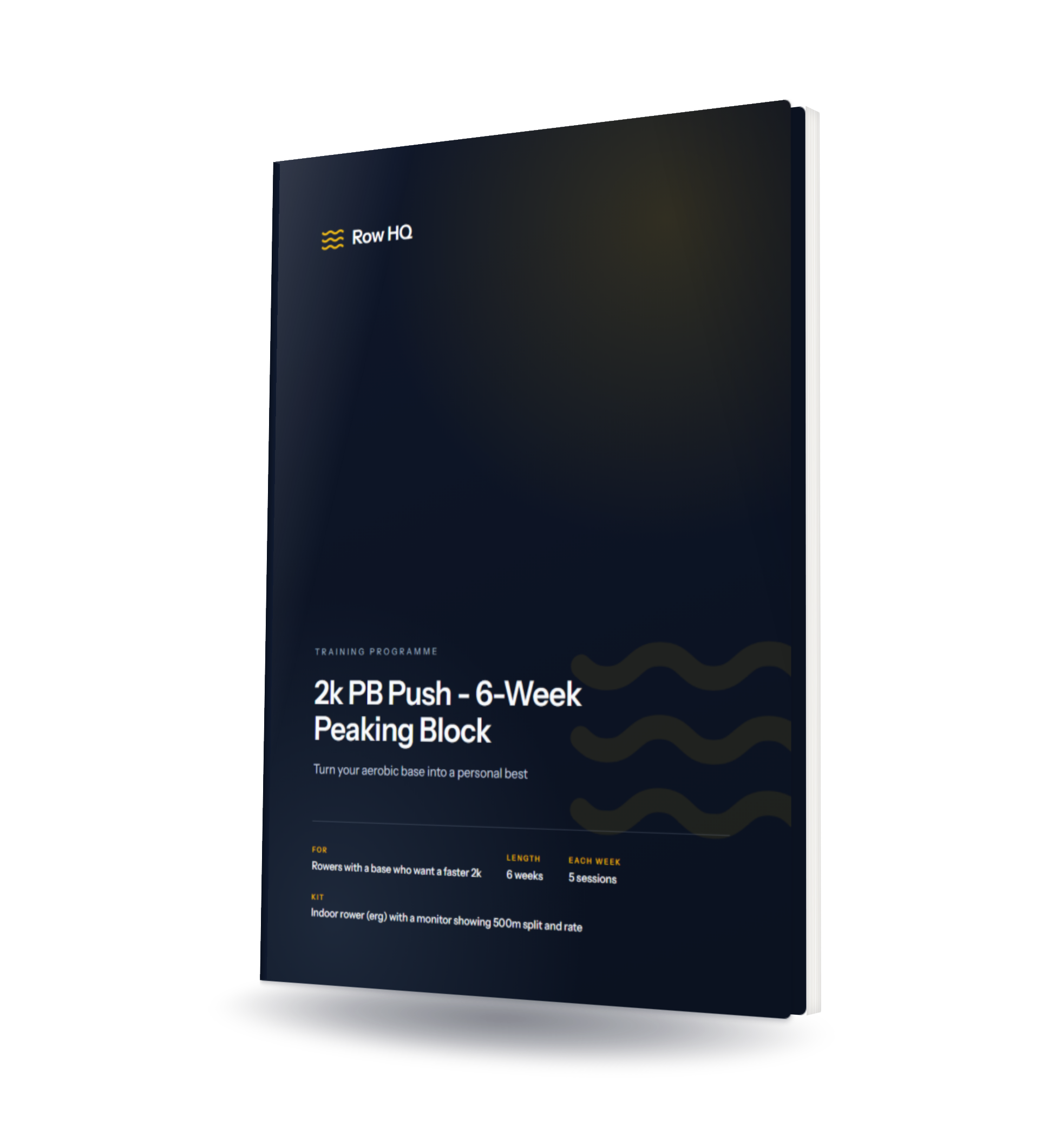
2k PB Push - 6-Week Peaking Block
Six weeks that turn an existing aerobic base into a 2k personal best - race-specific work, a proper taper, every pace scaled to your own time.
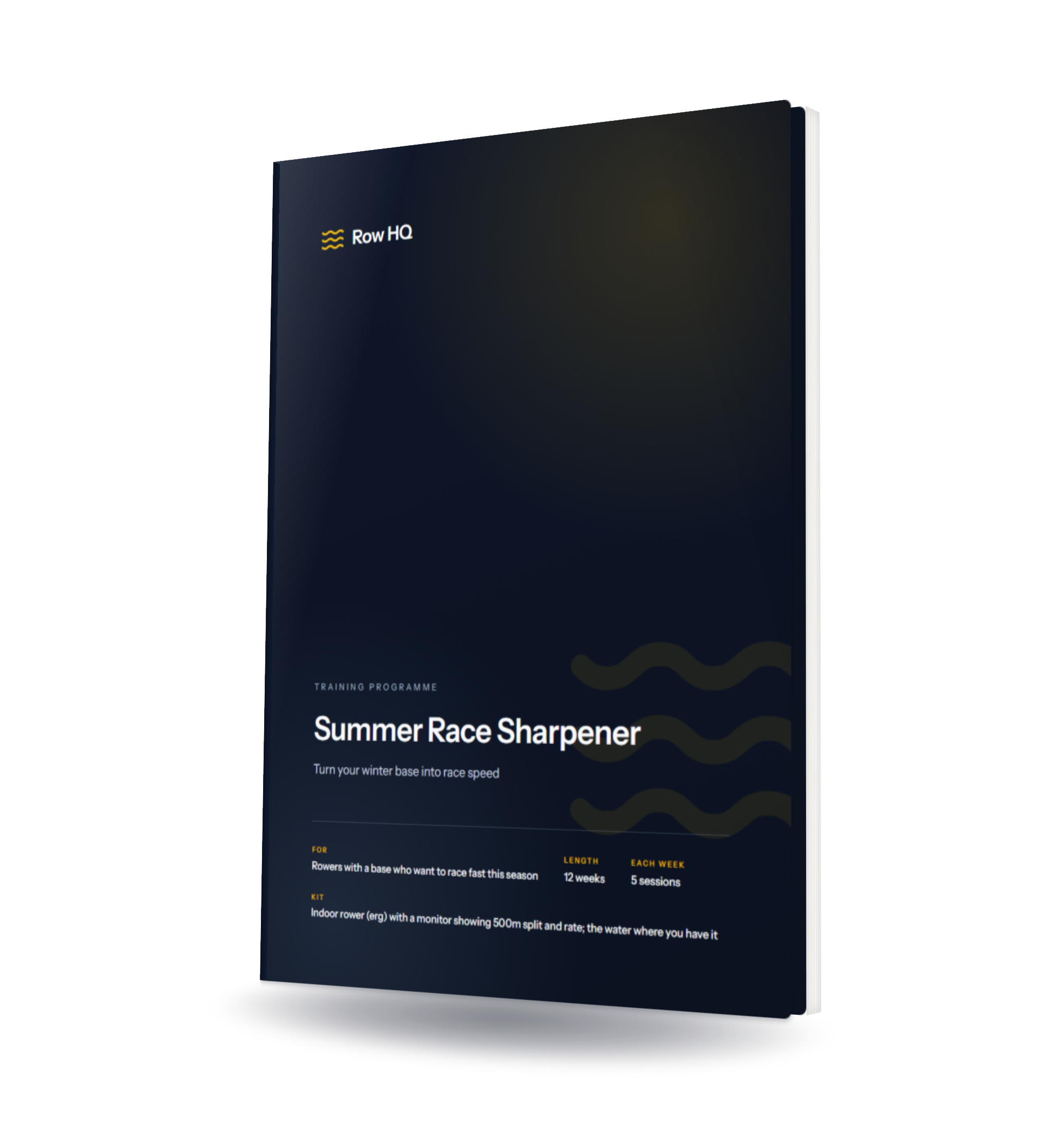
Summer Race Sharpener
Turn your winter base into race speed - 12 weeks that sharpen a big aerobic engine and peak you for a target regatta or 2k, every pace set from your own 2k.