The honest answer in 30 seconds
Pick a 2k split you can sit on for the whole seven minutes, not the one that flatters you for the first three. The shape that wins is the J-pattern: a sharp flyer over the first 15-20 strokes (roughly 4 seconds quicker than target), settle onto base pace by 250m, hold the boring line through 1500m, then a 30-stroke wind to the line. A positive split is the route to a bad afternoon. Use the 2k prediction calculator to pull a defensible target off a recent 5k or 6k, the watts-to-split converter to sense-check the watts, and benchmark against Rowing New Zealand shortlist marks if the score has to count for Maadi or Bond Cup selection.
Every Kiwi rower who has pulled a 2k carries a story about the day they folded at 1500m. Almost all of those collapses were preventable. Not by being fitter. By pacing the piece with a clear head. This is a guide to racing the 2k from the first stroke to the line, with target splits, the four shapes coaches watch for on the Concept2 PM5, and the on-monitor cues that keep an athlete honest when the legs have already gone. In Aotearoa the 2k is the central trial piece across the school and university season. Hamilton Boys, Saint Kentigern, Christ's College, St Andrew's, St Bede's. The piece runs through every Term 1 squad selection block from Otago University RC through to the pre-Maadi camps at Lake Ruataniwha. Pair this with our guide to the four ergo metrics worth tracking for the season-long view.
Why pacing wins or loses a 2k
A 2k is an awkward distance. Longer than a pure power piece. Shorter than an aerobic test. Roughly 70-80% of the energy is aerobic and 20-30% anaerobic, with the mix shifting by athlete. That balance punishes recklessness. Go out too hot and lactate stacks faster than the aerobic system can shift it. Somewhere between 1200m and 1500m the wall arrives, and the back half turns into damage control. Go out too soft and the score reads slow with fuel still in the tank. Neither outcome plays well at a pre-Maadi trial.
The fittest athlete in the boatshed will still fold if the pacing is wrong. Coaches across Rowing New Zealand affiliated programmes learn this lesson on repeat. The 2k rewards discipline before it rewards bravery. A controlled first 500m decides whether the second 1k is racing or simply surviving. The pressure compounds in February. Pre-Maadi erg trials at Hamilton Boys or Saint Kentigern decide seat-racing slots before anyone even loads a boat at Karapiro, and a wasted 2k can cost a rower the seat they were tracking toward all winter. Discipline in the opening 250m is worth more than a fast first split.
The four 2k pacing profiles
Watch enough 2k pieces on the PM5 and four shapes turn up over and over. Coaches read them off the splits-per-500 view in the Concept2 ErgData app or the Logbook. Three of these shapes leave time on the floor. One of them wins.
The four shapes of a 2k erg piece
Positive split - the fold
First 500 fastest, every later split slower. Feels heroic for three minutes. Brutal from 1200m on. The most common pacing error at every level and the surest route to a soft score. A blown pre-Maadi trial costs the score AND the head, going into seat racing. Bin it.
Flat split - the metronome
Four 500m splits inside roughly half a second of each other. Dull. Repeatable. The right call for a rower new to the 2k, or for anyone slotting one piece between two heavier sessions. Will not be a PB. Will be honest.
Negative split - the back-end push
Second 1k quicker than the first 1k. Physiologically tidy. Friendly to lactate clearance. Mentally it leaves real time on the table early. Coaches at performance programmes (Otago University RC, the Karapiro masters squads) use it for honest fitness testing where consistency beats a peak score.
J-pattern - the racing shape
Controlled flyer (first 15-20 strokes, around 4 seconds quicker than target), settle onto base pace by 250m, hold flat through 1500m, then 30 strokes of wind to the line. The shape Hamish Bond and Eric Murray ran in the M2- through their unbeaten run from 2009 to 2016. Their on-water race profile was textbook fast-start, brutal middle hold, controlled finish, and it transfers directly to the erg.
The J-pattern wins because it trades a sliver of physiological efficiency for a mountain of mental benefit. The early "free" seconds bank time you would otherwise be chasing once the legs are tired. The held middle 1k blocks the lactate flood. The back-half push spends the alactic and aerobic capacity an athlete has been quietly guarding the whole way through. Most coaches will let a junior shape one or two early-season 2ks as a flat split, then move them onto the J once they have a real feel for the piece. The Bond and Murray template is the model. Drysdale ran the same shape in his single, and Mahe's 2009 World Championship gold final at Poznan is still the cleanest video clinic on a fast-start, even-middle, controlled-finish 2k.
Elite male rowers in our analysis adopted a fast-start, even-pace strategy in the 2,000m on-water race, with the first 500m the fastest section and the middle 1,000m held at a remarkably even pace - a pattern that maximises performance under the energetic demands of the event.
Step-by-step: first 500, middle 1k, final 500
A good 2k is three pieces of work stitched together, not one. Break it into the start, the body and the sprint. Hold a split, a rate and a feel target for each.
First 500m - controlled flyer, then settle
Open with 5 hard strokes at rate 42-44 to get the wheel moving, then 10-15 power strokes at rate 36-38 about 4-5 seconds under target split. By 30 strokes in the rate should be at base (typically 32-34 for senior men, 30-32 for senior women, with juniors and masters dropping 2 beats off race rate) and the split sitting 1-2 seconds under target. If the monitor shows 4 seconds under target at 250m, the piece is already cooked. Settle. Right now.
Middle 1000m - hold the boring line
From 500m to 1500m the job is to do nothing interesting. Hold target split. Hold base rate. Resist the temptation to "feel out" the piece with 10 hard strokes to see if there is more in there. There always feels like more in there at 700m. There is not. The middle 1k is also where the mental game starts. Around 1000m the discomfort steps up sharply as lactate starts to bite. Kiwi coaches call this the dark place. The only right response is to sit on target split and let the rate do the work.
Final 500m - 30 strokes to the line
At 500m to go, lift the rate by 2 (typically to 34-36 for the main push), commit to taking the split down by 1-2 seconds, and accept the next 90 seconds will hurt at a level the rest of the piece never approached. At 250m to go, sprint. Rate climbs to 38-42. Drive every kilojoule into the stretcher and bury the split as low as it will go. The final 20 strokes will look ugly. Nobody cares. Cross the line. Log the score.
Worked example: a clean 7:00 2k via the J-pattern
Target split 1:45.0. Rate plan 36-32-32-34-38-42 across start, body, build and sprint.
Flyer settles to base
Held at target
The dark place
Build, then sprint
How to set your target split
Race the split you have evidence you can hold. Guessing leads to folding. Four anchors for an upcoming 2k target, all of them better than rounding down off your last PB:
-
Predict from a longer piece: the most reliable method. A recent 5k or 6k feeds the Riegel endurance model and lands a 2k prediction within a couple of seconds for most trained Kiwi athletes. Drop the figures into our 2k prediction calculator and pull a defensible target. Most NZ school programmes lean on this approach for any athlete who has not pulled a 2k inside the last 8-12 weeks, which covers almost everyone going into the pre-Maadi block.
-
Anchor to training paces: UT2, UT1 and AT splits should sit in predictable ratios to a real 2k split. If a Karapiro winter AT block has been settling at 18-20 seconds slower than the proposed target, the target is honest. If AT is 25 seconds slower, the target is fantasy. The training pace calculator lifts out the full UT2-UT1-AT-TR-AN band off one input.
-
Sense-check the wattage: a 1:45 split is 313 watts. A 1:40 split is 363 watts. Concept2 derives watts from split via 2.80 / (split_seconds / 500)^3. If the target split implies a watt output 30%+ above anything an athlete has ever held for a 6-minute interval, the goal is implausible. The watts-to-split converter reads both directions.
-
Cross-check against VO2 max: 2k pace correlates tightly with VO2 max for trained rowers (Hagerman established this for the boat-class athlete population in the 1970s and 1980s). Our VO2 max calculator takes a 2k time and returns a predicted VO2 max, and reads backwards as a plausibility check on a goal. The full rowing calculators suite covers the rest.
Race-day mental approach
Past 1000m the 2k is more head than legs. Cardio-respiratory limits matter. So does the ability to keep pulling when the rational brain has switched off. Five mental tools that hold for most Kiwi athletes:
- Chunk the piece: race four 500m intervals, not a 2k. Reset the mental countdown each split. "One quarter gone." "Halfway." "One to go."
- Pre-script the ugly moments: decide before you sit down what you will tell yourself at 1000m, 1500m and 250m to go. "Hold the split." "Build now." "Empty it." Pre-written self-talk beats invented self-talk every time, because the rational brain has already left the boatshed by 1500m.
- Lock onto the split, not the metres: stare at the split line, never the distance remaining. Distance remaining is demoralising at 1200m. The split is actionable.
- Use a coach call: a coach or training partner calling rate at 1500, 1000, 500 and 250 to go is worth real seconds. Booking it in advance also locks the athlete into the piece. Hard to bail when someone is watching.
- Breathe to the stroke pattern: two-stroke breathing (in on drive, out on recovery, then in on recovery, out on drive) keeps oxygen delivery steady through the back half. Most folds carry a respiratory tell about 30 strokes before the split goes.
Common pacing mistakes
Five errors account for the bulk of folded 2ks. Spot them in your own racing and the next test goes better:
-
Going out at 1k pace: the most common error. Adrenaline plus a fresh body produces a first 500 that is 5-8 seconds under any defensible target. The arithmetic is unforgiving. Every second banked in the first 500 costs 2-3 seconds in the back half.
-
The 1500m fade: split holds through 1000m, drifts 2-3 seconds across 1000-1500m, then the sprint never arrives because the legs are already cooked. Almost always traceable to a positive-split first 1k. Hold the middle 1k at target and the sprint comes back online.
-
Late sprint: saving everything for the final 250m. The numbers do not work. Carving 4 seconds off the last 500 cannot rescue a back half that drifted 6 seconds outside target. Build from 500m to go. Not from 250m.
-
Rate creep through the middle 1k: athletes who lose split tend to chase it with rate, which feels productive and burns fuel. Watch base rate at every quarter. If it has climbed 2 beats between 750m and 1250m, the wheels are coming off. Consciously settle the rate back down.
-
Watching time remaining instead of the split: "how long is left?" is the wrong question past 1000m. "Is the split where it should be?" is the right one. The first invites bailing. The second invites discipline.
Federation testing protocols
If a 2k score needs to count for selection (Rowing NZ shortlist, NZURA Bond Cup, a school Maadi seat-racing trial, masters age-graded targets) it has to be pulled under a published protocol. The relevant English-language standards each set their own expectations, and a score pulled outside any protocol is not honestly comparable to a benchmark.
-
Rowing New Zealand - selection testing context: Rowing NZ publishes squad benchmarks and runs trial weeks through the high-performance environment, with Concept2 RowErg the universal standard for fitness data. School and university programmes typically pattern their pre-Maadi and pre-Bond Cup trials on the same warm-up, drag and notation conventions, and log scores with body weight, drag factor and a coach signature against the athlete record. Karapiro is the canonical venue. Lake Ruataniwha runs the parallel testing camp before Maadi week.
-
USRowing - National Team Testing Standards: USRowing testing protocols set 2k, 5k and 6k benchmarks for senior, U23 and U19 national team selection. CRASH-B Sprints (Boston) caps drag factor below 130 for record verification. A useful reference point for any Kiwi athlete benchmarking against the indoor championships circuit.
-
Rowing Australia - performance standards: Rowing Australia works through the state institutes (NSWIS, VIS, QAS, WAIS, SASI) for talent ID and squad selection, with Concept2 2k scores benchmarked against published age-group standards. The closest analogue to the NZ high-performance pathway, and a useful sanity check for any cross-Tasman athlete comparing scores between programmes.
Frequently asked questions
What counts as a good 2k erg time in New Zealand?
Depends on age, sex and weight. For openweight senior men, sub 6:30 is competitive club level, sub 6:00 is at NZURA Bond Cup standard, and sub 5:50 sits in the Rowing NZ shortlist neighbourhood. For openweight senior women, sub 7:15 is competitive club, sub 6:50 is Bond Cup standard, sub 6:35 is shortlist territory. Lightweight men under 6:30 and lightweight women under 7:20 are strong scores. Top Maadi 1st VIII rowers usually sit between 6:25 and 6:50 by selection week. Juniors and masters scale against the Concept2 age-graded tables, not the open columns.
What is the best 2k erg pacing strategy?
The J-pattern. A 5-stroke start at rate 42-44, settle onto base rate 32-34 at 1-2 seconds under target split through the first 500, hold target through 1500m, then lift rate by 2 and build the split down across the final 500, sprinting from 250 to go. The shape that produced almost every meaningful Kiwi 2k PB, and the same on-water profile Hamish Bond and Eric Murray rode through their unbeaten M2- run.
How fast should I go out in the first 500m?
Roughly 1-2 seconds under target average split. No further. If the target is 1:45 and the monitor reads 1:43 at the 250m mark, you are on. If the monitor reads 1:40 you are gone, and the back half between 1200m and 1500m will collect the bill. The opening 5 strokes can be hard (rate 42-44) to spin the wheel up, but by 250m the rate has to be settled and the split has to be honest.
What stroke rate should I use for a 2k erg test?
Senior men typically settle at 32-34 through the body, lift to 36-38 across the final 500 and 38-42 in the sprint. Senior women usually sit at 30-32 base, lift to 34-36, and finish at 36-40. Juniors and masters generally rate 2 beats lower across the board. Higher rates do not guarantee faster splits. Watts per stroke matters more, which is why a controlled rate with a clean drive sequence routinely beats a thrashy 38.
How do I avoid folding at 1500m on a 2k erg test?
Three things. First, hold the first 500m to 1-2 seconds under target, never 4-5. Second, do not chase the split through the middle 1k. Sit on target even when the monitor whispers that you could go faster. Third, pre-script self-talk for 1000m and 1500m so the rational brain has a plan once it has clocked off. The fold is almost always paid in the back half for a fast first 500.
Should I negative-split a 2k?
For a fitness test or the season-opening 2k, yes. It is forgiving and produces a clean honest score. For a peak test chasing a PB, the J-pattern wins because the controlled fast start banks 1-2 seconds the negative split leaves on the floor. Kiwi coaches usually run novice rowers on negative splits to build pacing confidence first, then move them onto the J-pattern once the piece feels familiar.
What drag factor should I use for a 2k erg test?
Senior heavyweight men usually pull at 130-140. Lightweight men, junior men and senior women typically at 110-130. CRASH-B Sprints caps drag below 130 for record verification, so testing above that means a score does not compare against the indoor championships. Rowing NZ trial conventions leave drag open within sensible bands but log it alongside the score for fair comparison across testing periods. The number stays attached to the athlete record. Set it once at warm-up and do not fiddle.
How long should I rest before a 2k erg test?
Most coaches taper for 2-3 days before a peak 2k. Drop volume by 30-50%. Keep one short sharp piece (a 2 x 500 at 2k pace +1) 48 hours out. Rest the day before. A 20-minute warm-up on the day is the standard: 15 minutes of UT2, three rate ladders, two power 10s. Pulling a 2k cold or stacked on top of a heavy 24 hours of training is the quickest route to a disappointing score and a sour mood at trials.
The bottom line
The 2k erg test rewards pacing discipline ahead of bravery. The athletes who PB consistently are the ones who set a defensible target, hold the boring middle, and trust the back-half push. The athletes who fold at 1500m are almost always the ones who decided at 250m that today felt like a fast day. Set the target with the 2k prediction calculator, sense-check the watts with the watts-to-split converter, and race the J-pattern Bond and Murray made famous.
For coaches running a squad, the real win is logging every 2k under a consistent protocol so scores compare honestly across a Karapiro winter, a pre-Maadi camp at Lake Ruataniwha and the spring sprint regattas. Row HQ's coach tools and member portal handle the logging and ranking, so the test debrief is about pacing shape and pre-scripted self-talk instead of trawling old test sheets. Get started, book a walkthrough or read through the pricing. The FAQ covers the common setup questions.
- The Row HQ Team
Sources & references
- Rowing New Zealand - high-performance and coach education resources — Rowing New Zealand
- Maadi Regatta - NZ secondary schools rowing championship — NZSSRA
- New Zealand Universities Rowing Association (Bond Cup) — NZURA
- Concept2 PM5 monitor reference — Concept2
- Concept2 ErgData app (free splits and stroke data capture) — Concept2
- Concept2 Online Logbook — Concept2
- Concept2 watts calculator (2.80 / (split_seconds / 500)^3) — Concept2
- Concept2 World Rankings - 2k benchmarks and age-graded tables — Concept2
- Mikulic, Smoljanovic & Bojanic (2009) - Pacing strategy in international rowing — PubMed / Journal of Strength and Conditioning Research
- Hagerman - Applied physiology of rowing (foundational VO2-to-2k research) — PubMed / Sports Medicine
- Garland (2005) - An analysis of the pacing strategy adopted by elite competitors in 2000 m rowing — PubMed / British Journal of Sports Medicine
- New 2k world record 5:35.8 (Josh Dunkley-Smith, AUS, 2018) — Concept2
- Riegel endurance model (basis for distance/time prediction) — Riegel
- C.R.A.S.H.-B. Sprints (World Indoor Rowing Championships), Boston — C.R.A.S.H.-B.
- Row HQ 2k prediction calculator — Row HQ
- Row HQ watts-to-split converter — Row HQ
Related articles
From the RowHQ shop
Printable PDFs written for club rowers. Buy once, keep forever.
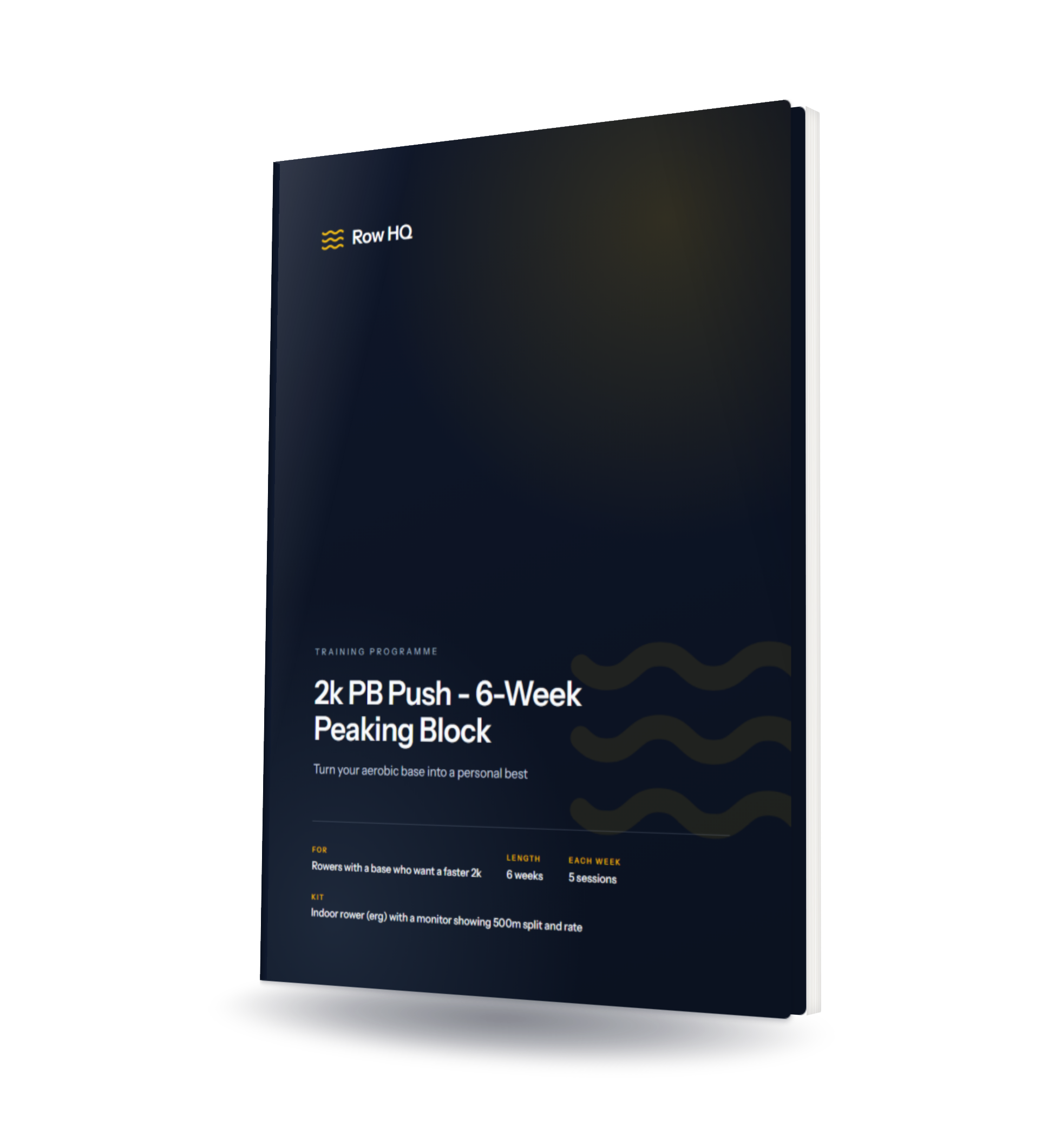
2k PB Push - 6-Week Peaking Block
Six weeks that turn an existing aerobic base into a 2k personal best - race-specific work, a proper taper, every pace scaled to your own time.
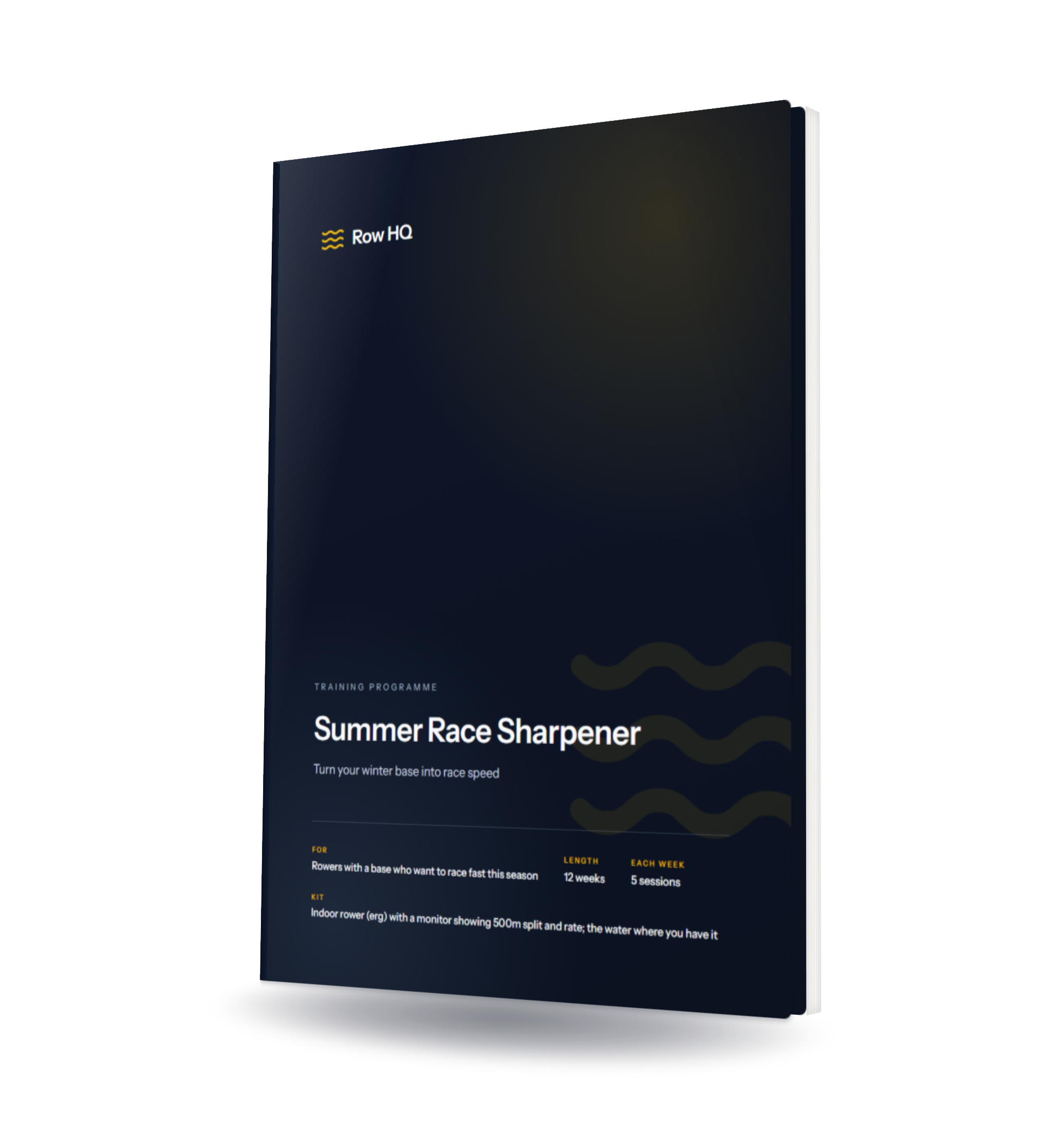
Summer Race Sharpener
Turn your winter base into race speed - 12 weeks that sharpen a big aerobic engine and peak you for a target regatta or 2k, every pace set from your own 2k.