The honest answer in 30 seconds
Four PM5 readings sit behind every defensible US lineup call: 2k time, 500m split, watts and stroke rate. Run a bimodal calendar around them, fall 6k and 2k trials before HOCR selection, winter base on the 5k and 6k, a spring 2k retest before sprint season, and a final selection 2k two weeks out from IRA. Lock drag factor (heavyweight men 130-140, lightweight and openweight women 110-130, with CRASH-B Sprints capping below 130 in Boston), log weight at every test, and feed the file straight through ErgData into the Concept2 Online Logbook. Everything else on the monitor is texture once those four columns hold up.
Walk into the Princeton boathouse on Lake Carnegie in late January, or into the Conibear shellhouse in Seattle, and you will see the same scene. A line of Concept2 RowErgs, a head coach holding a clipboard with twelve names on it and eight seats to fill, and an assistant scrolling through PM5 history on the wall display. The ergometer is the gatekeeper for varsity selection at every NCAA D1 women's program in the country and at every IRA-qualifying men's club program from Cal to Yale. Done right, the data settles the seat-racing argument before seat-racing starts, defends the scholarship conversation when the athletic director walks in, and gives a junior recruit something concrete to email Mike Teti, Tom Terhaar or any other US college coach. This guide covers what to actually read off the screen, when to test through the US season, and how the training response features inside Row HQ wrap around the workflow.
Why the erg still settles arguments
On Lake Natoma, on the Schuylkill, on the Cooper River, on the Charles, on Mercer Lake, results are a mess of tailwind, swing and the coxswain's call at the 1500. Strip the boat out and you get one athlete, one machine, one number, repeatable from Princeton to Berkeley to Knoxville. That is why the Concept2 stays the single most-quoted data point in US college rowing. Three jobs it does that nothing else does cleanly:
-
Benchmarking: Establish a squad baseline that holds up against published Ivy League and Big Ten cutoffs. Used well, it answers the unavoidable crew selection question of who deserves a 1V8+, who slides to the 2V8+ and who anchors a freshman boat, without the lineup meeting turning into an opinion contest.
-
Progress tracking: Read the curve across the bimodal US calendar. September through HOCR, then the winter base block out of CRASH-B, then the spring rebuild into IRA. A real training response shows up on the PM5 weeks before it surfaces in a 2k or in seat-racing.
-
Goal setting: "Get faster" is empty. "Drop a 2k from 6:34 to 6:28 by CRASH-B" lands. A junior with a verified 6:30 with drag factor logged is the file the women's programs at Stanford, Brown, Texas, Tennessee, and Yale want to see before any official visit conversation starts.
Some sense of the dataset Concept2 sits on top of. In 2025 alone, the official logbook recorded:
Four PM5 numbers that drive lineup calls
The Concept2 PM5 dumps a wall of telemetry across every piece. Most of it is decoration once a coach knows what they are reading. Lock onto these four and you have the file that survives an AD review (the ergometer glossary entry covers the definitions in plain language):
PM5 readings coaches actually track
2k Time
The headline number on every NCAA recruiting profile and every IRA selection sheet. National team contenders break six minutes for heavyweight men and 6:30 for openweight women. A varsity 1V women's seat at a Title IX scholarship program typically sits inside 7:00. Heavyweight men chasing an IRA invite sit at 6:30 or quicker. Tenths matter, not seconds.
500m Split
Average pace per 500 meters. Coaches read negative-split pieces (a quicker back half) as evidence of pacing discipline; a 1k that drifts four seconds outside the opening 1k flags a mental crack at the 1500-meter mark. The line every US head coach watches stroke by stroke across a selection 2k.
Watts
Raw flywheel power, weight-independent for heavyweight comparison. Concept2 derives it as 2.80 / (sec_per_500 / 500)^3. A 6:00 heavyweight man averages around 425W. A 7:00 openweight woman sits near 270W. Pair watts with body weight and the lightweight calculus stops being a guess.
Stroke Rate
Cadence in strokes per minute. A 2k selection piece typically settles between 32 and 38 SPM depending on the athlete. Divide watts by rate and you get watt-per-stroke, the line that exposes who genuinely loads the wheel and who spins the handle at the 1250 to fake a number.
It's the best all-round fitness machine in the world, and suitable for anybody, not just international athletes. No matter how hard I tried, I could never beat it. It never broke and it never let me down.
Where Row HQ fits inside a college boathouse
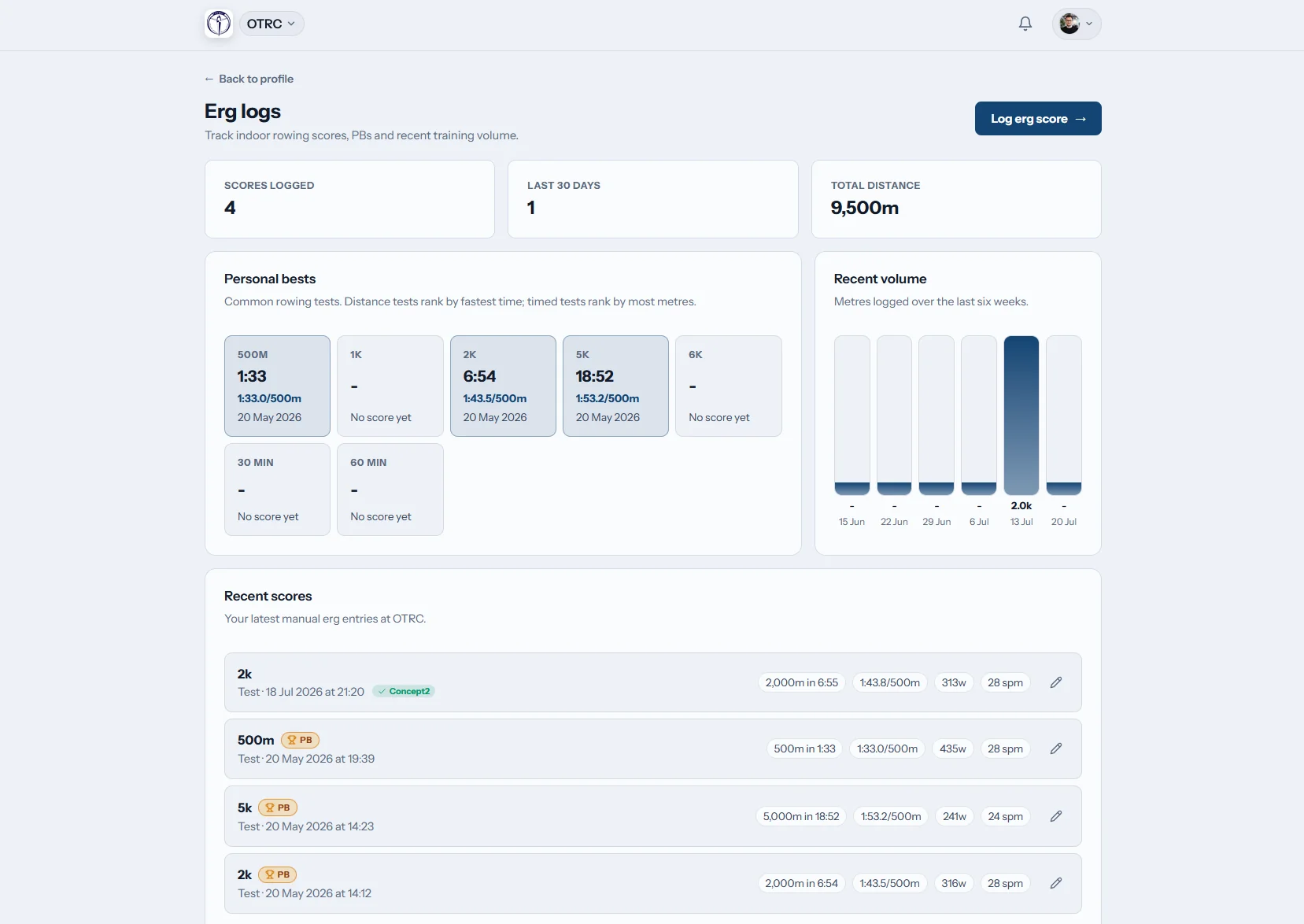
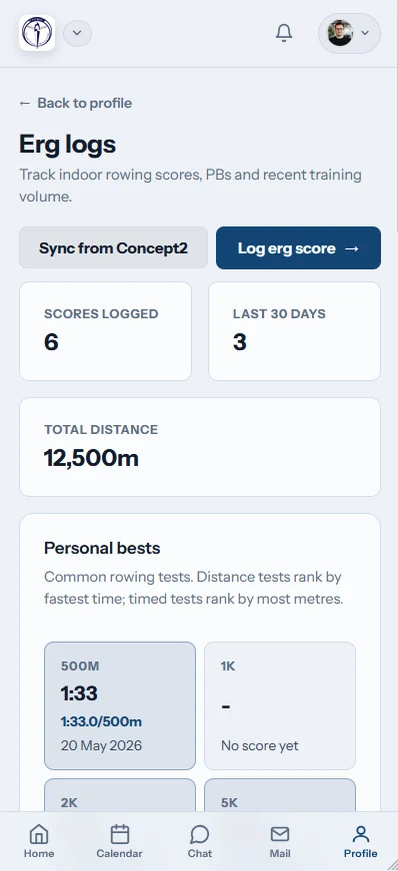
Pulling a 2k is the easy half. Holding a coherent record of every athlete’s 2k, 5k, 6k, 4 x 2k and 4 x 1k across four years, then handing the head coach the right slice on the morning of selection without an hour of spreadsheet rebuilding, is where most programs leak hours every week. Row HQ’s erg log, wired into our coach tools, writes every result against the athlete profile and produces the kind of documented testing record an athletic department or a USRowing Selection Camp invitation expects. Athletes upload PM5 results today via the athlete portal or CSV; direct Concept2 Logbook API sync (via ErgData) is on our near-term roadmap, so scores flow in without a coach touching a keyboard.
-
Easy logging: Athletes upload PM5 results from a phone via the athlete portal the moment they step off the rower. The era of paper sheets, GroupMe threads and a head coach's broken Excel template is over (look at our spreadsheet comparison for what that costs you in lost data).
-
Historical data: Every score sits against the athlete record across freshman, sophomore, junior and senior years. Pull any window in two clicks: fall preseason vs winter peak, last week vs last March, this 2V8+ candidate vs the 1V8+ holder she is chasing for a seat.
-
Coach review: The head coach opens the admin dashboard and reads the squad ranked by current 2k, weight-adjusted watts and trajectory. When the AD asks why a particular athlete kept her scholarship and another did not, the file is already on the screen.
-
Personal bests: The system flags a new PB the second it lands. Athletes can pull a verified PB history from the athlete portal and forward it straight to college recruiters during the junior and rising-senior cycle.
Turning numbers into boat speed
A leaderboard taped to the boathouse wall is not a program. The data only earns its keep if it changes what the athlete and the coach do next. Four patterns that separate the programs winning at Eastern Sprints and IRA from the programs that show up:
- Celebrate trajectory, not just absolutes: A walk-on freshman who drops 14 seconds off her 2k between September and CRASH-B is doing exactly what the program needs, even if she is still 20 seconds off the 1V8+ standard. Surface the slope of the line, not just the ranking column.
- Build honest competition: Class-year leaderboards (freshmen against freshmen, not against fifth-year transfers from Wisconsin) feel fair and fire athletes up. The practice planning tools attach erg trajectory directly to seat-racing results so the link between gym work and boat speed stays visible to the squad.
- Identify weaknesses: An athlete whose first 1k is consistently four seconds quicker than her second 1k has a pacing problem, not a fitness problem. The data points the coach at the right intervention in the next practice session instead of asking her to "just hold it".
- Track training load: Cross-reference erg performance against weekly meters (the Concept2 staple) and steady-state hours. When 2k splits start drifting outward in mid-March, you are looking at over-reaching ahead of IRA, not laziness. Pull volume back before the program turns into burnout three weeks from sprint season.
A walk-on freshman, fall preseason to CRASH-B
Opening 2k benchmark
Drops 14 seconds
Inside the 1V8+ band
5.7 percent quicker overall
Protocol habits the top boathouses share
Sloppy protocol means the file you hand the AD will not survive a hard question, and the recruit-side number you forward to a college coach gets quietly discounted. The programs whose data holds up standardize ruthlessly. Five habits worth copying:
- Standardize test conditions: Same morning of the week, same warm-up (15 minutes of UT2 plus three rate ladders is the Concept2 default), same drag factor every single time. Heavyweight men pull at 130 to 140; lightweights and openweight women at 110 to 130. CRASH-B Sprints in Boston caps drag below 130, so testing above that produces a score you cannot benchmark against the indoor championship. Run the setup through our drag factor calculator per athlete and lock it in the file.
- Match the testing rhythm to the US calendar: Fall 6k and 2k trials before HOCR selection in October. Winter base on the 5k and 6k through January. A spring 2k retest before sprint season opens at San Diego Crew Classic. A final selection 2k roughly two weeks before IRA, EAWRC Eastern Sprints or Pac-12 Heads. The Pete Plan and the Concept2 published training plans both build around this bimodal shape; copy what already works.
- Record everything: Final time, every 500 split, peak SPM, body weight at the test (timed to the warm-up, not the previous evening), and one honest sentence from the athlete on how the piece felt. Lightweight athletes especially need weight stamped, a 6:35 at 165 lbs and a 6:35 at 175 lbs are different conversations with both the coach and the recruiter.
- Create a supportive environment: A 2k erg test is one of the worst seven minutes an athlete will voluntarily put herself through. Programs that treat the bottom of the depth chart with the same respect as the top tend to get more out of the full roster, and that culture shows up in IRA selection week when the V8+ and 2V8+ need each other to push speed.
- Review and discuss: One-on-ones with each athlete in the week after every 2k. Walk through the splits, set the next target against published Ivy or Big Ten cutoffs, and write the next month of training from that conversation. Pair the talk with a 2k prediction calculator when the only fresh data is a 5k or 6k.
When athletes can see the actual line on the chart, 7:42 in September to 7:15 by CRASH-B, the erg stops being a verdict and becomes a target. Programs we work with see this shift play out the same way every season, freshman year and senior year alike.
What this adds up to
The erg never replaces seat-racing or a head coach's eye for boat-moving. It backs them up. A clean Concept2 record gives the staff air cover when scholarship calls go to the athletic department, gives a junior recruit a credible pitch to a women's D1 program, and gives the squad something concrete to chase through a long winter base block. The coach tools in Row HQ are built around exactly that workflow.
Row HQ takes the recording, ranking and reporting off the head coach’s plate. No more missing test sheets, no more 11pm spreadsheet rebuilds before lineups go up on the wall. Verified Concept2 results, sorted by current standing and seasonal arc, ready for the head coach, the AD and the recruit-side inbox. Need to crunch a split on the fly? Run our open erg pace calculator; it converts any split to wattage, calorie pace and projected finishing times from 500m through a marathon piece. Tour the product screenshots for the log in motion, review pricing, or get started. The FAQ answers the common questions.
The erg log is one feature inside Row HQ, the same platform that manages the practices those scores come out of.
Jason Burns, Row HQ
Sources & references
- Concept2 PM5 monitor reference — Concept2
- Concept2 Online Logbook — Concept2
- Concept2 2025 Year in Review (141,735 new athletes, 79.7B m, 210+ countries) — Concept2 (accessed May 17, 2026)
- New 2k world record 5:35.8 (Josh Dunkley-Smith, AUS, 2018) — Concept2
- Trends in indoor rowing records — World Rowing
- C.R.A.S.H.-B. Sprints (World Indoor Rowing Championships), Boston — C.R.A.S.H.-B.
- USRowing - rules, selection and athlete development pathway — USRowing
- IRA National Championship Regatta — IRA
- NCAA Division I Rowing Championship — NCAA
- Why Sir Steve Redgrave uses the Concept2 rower — Fitness Etc
- Row HQ erg pace calculator (split to watts, calories, projected times) — Row HQ
- Row HQ 2k prediction calculator (from 5k/6k pieces) — Row HQ
- Row HQ drag factor calculator (per-athlete setup) — Row HQ
Read next
From the RowHQ shop
Printable PDFs written for club rowers. Buy once, keep forever.
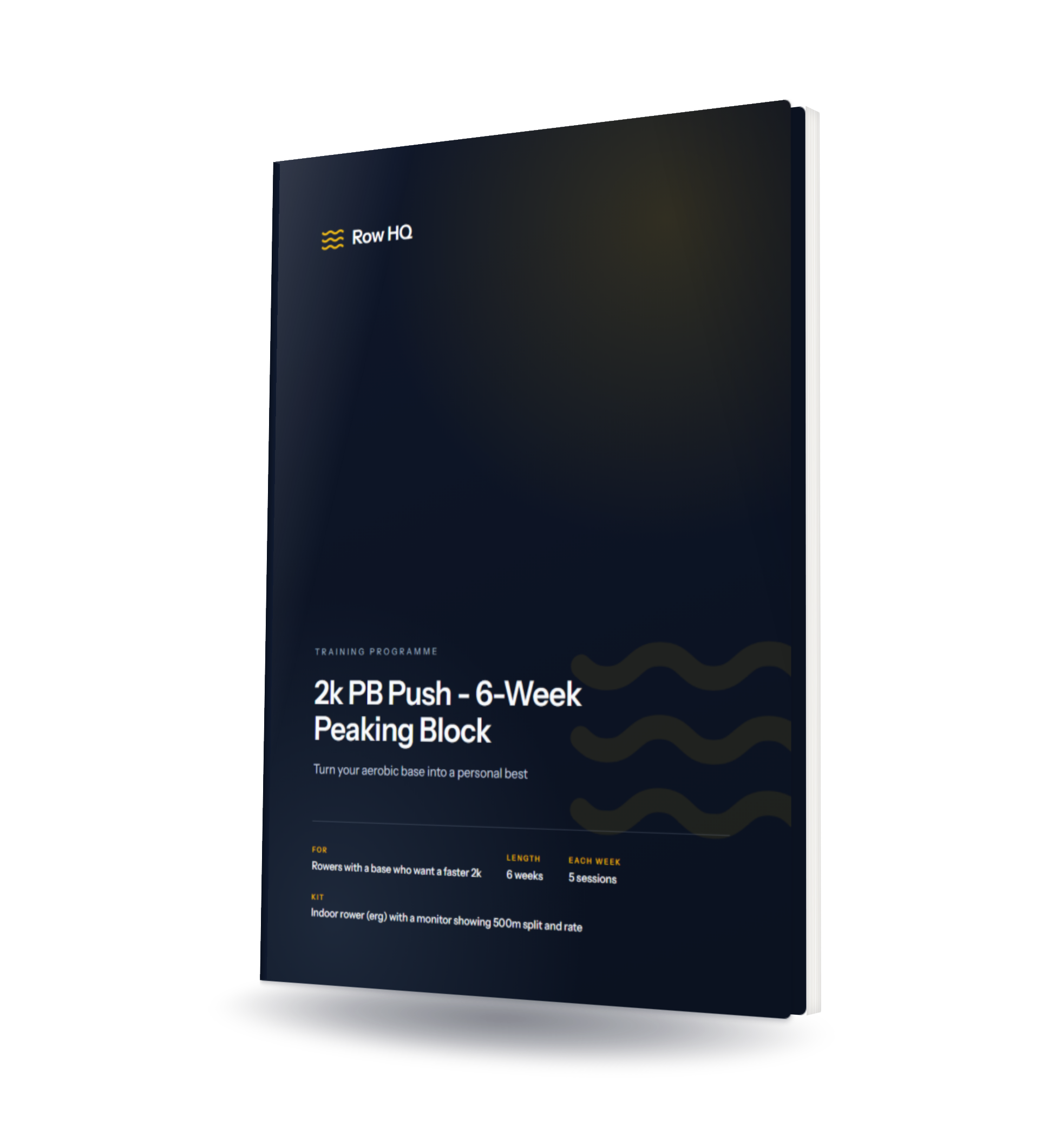
2k PB Push - 6-Week Peaking Block
Six weeks that turn an existing aerobic base into a 2k personal best - race-specific work, a proper taper, every pace scaled to your own time.
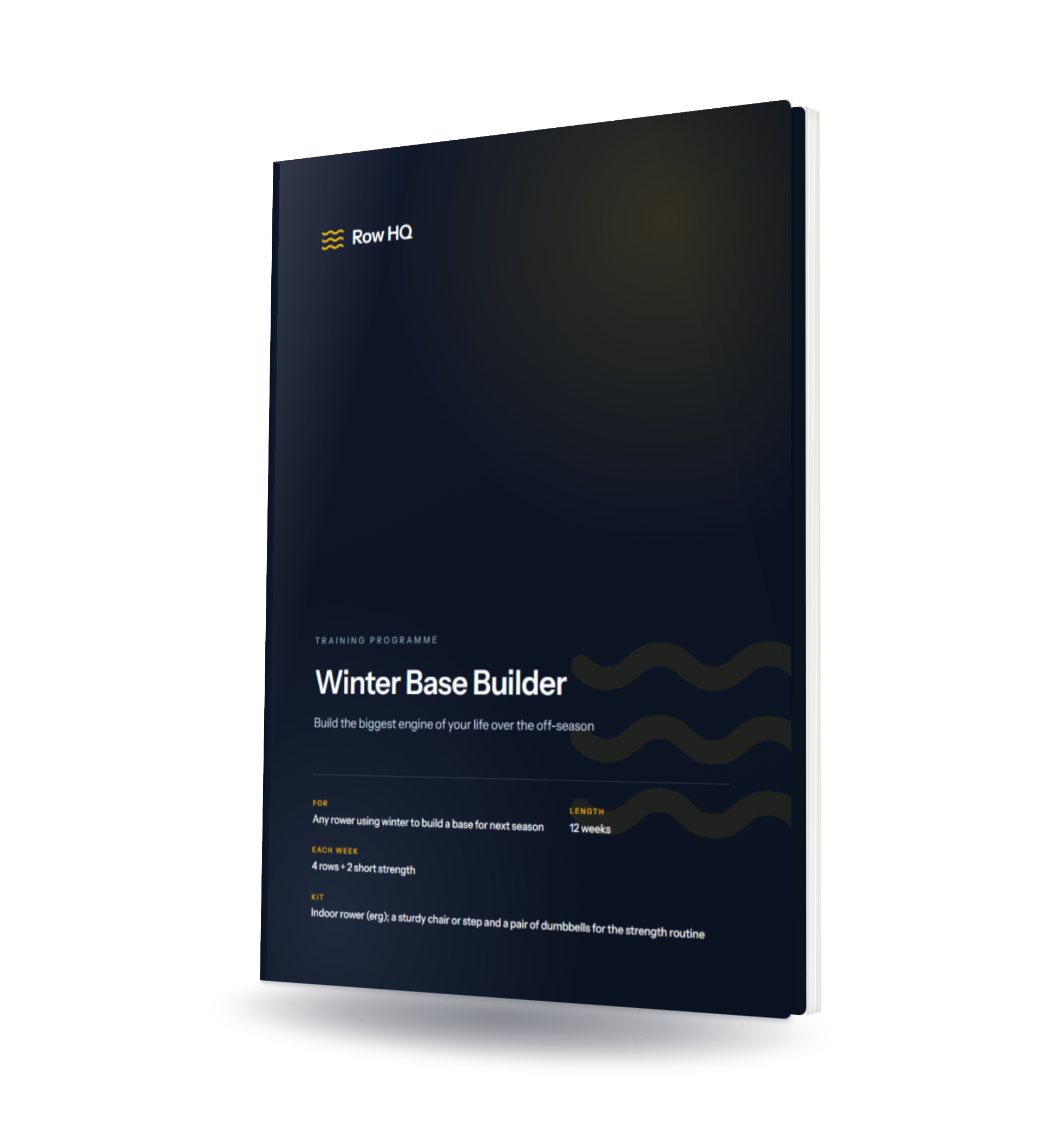
Winter Base Builder
Build the biggest engine of your life over the off-season - 12 weeks of mostly-easy volume plus a strength routine, so you arrive at spring fast.

The Club Session Library
52 rowing sessions for club coaches, with an illustrated coaching PDF, editable CSV plans, two seasonal blocks and a printable coaching cheat sheet.