Recovery
The recovery is the slide forward between strokes - the section of the stroke cycle that runs from blade exit at the finish back to blade entry at the next catch. Hands away, body forward, slide forward, in that order. The hull is gliding on inertia. The rower applies no force. Patient recoveries are how fast crews stay fast.
The Recovery: Patient Slide Forward Between Strokes
The recovery is the non-propulsive section of the rowing stroke that runs from blade exit at the finish back to blade entry at the next catch. Hands away, body forward, slide forward, in that order. The hull is gliding on inertia and the rower applies no force to the spoon. Recovery time runs two to three times the drive time at training rates and closes toward 1:1 at race pace. Long, controlled recoveries are the hallmark of fast crews.
Also called: Recovery Phase, Slide Forward
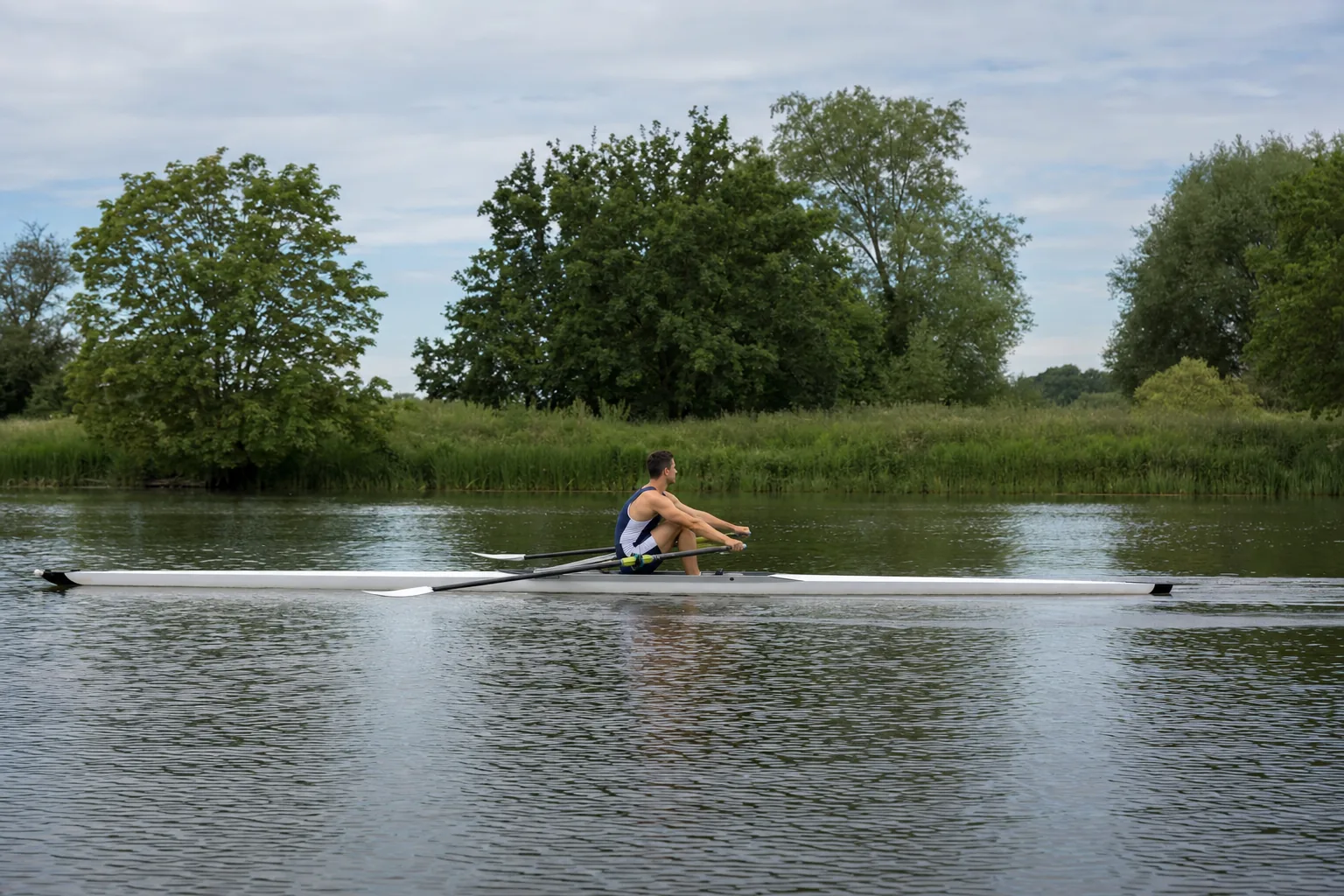
What the recovery is
The recovery is the half of the rowing stroke that happens between drives. The spoon has just left the water at the finish, and the rower needs to slide forward into the next catch position. Through the whole recovery the blade is above the surface (feathered, then squared again before the front stop) and no force passes from rower to spoon. The hull keeps moving by inertia from the previous drive.
Aussie sheds use "recovery", "slide forward" and "return" interchangeably. It is the only part of the stroke where the rower is not directly producing hull speed, but it is the part that decides whether the hull runs cleanly between strokes or stutters into the next catch. A crew that respects the recovery looks smooth; a crew that doesn't looks busy.
Hands away, body forward, slide forward
The recovery sequence runs in three distinct stages, in order:
- Hands away: the arms extend toward the bow while the rower stays in the lay-back position. The handle moves away from the body until the elbows are straight. Seat does not move yet.
- Body forward: the back swings forward from lay-back through vertical and on into the body-over position (chest over the knees). The seat is still pinned at the back stop.
- Slide forward: only after the body angle is set does the seat start to move. The slide is gradual and only accelerates as the rower approaches the front stop, never an aggressive lunge.
Recovery pace and the drive-recovery ratio
The recovery should be slower than the drive. At training rates of 18 to 22 it takes two to three times as long as the drive, which is the 1:2 or 1:3 ratio that defines a relaxed UT2 paddle. The hull has plenty of time to glide and the rower has plenty of time to sequence the recovery cleanly without rushing the catch.
At regatta race rate of 36 to 40 the recovery compresses hard and the ratio drifts toward 1:1. Crews that hold the longest possible recovery as the rate climbs are the ones who hold seats in the third 500 of a 2km. The stroke rate calculator converts rate and split into distance per stroke so the difference between a rushed slide and a patient one becomes a number rather than a feeling.
Let the boat come to you
Beginners almost always recover too fast. The instinct is to "get back to the next stroke" as quickly as possible to apply more power. But more strokes per minute do not mean more boat speed - shorter slides mean shorter strokes, less distance per stroke and less hull run. Aussie coaches phrase the fix as "let the boat come to you" or "ride the run", both meaning the same thing: trust the previous drive to do its work and don't reach for the next one early.
A patient recovery does three things at once. It gives the hull more time to glide on the previous drive's momentum, which increases distance per stroke. It gives the rower's legs and back a brief unloaded recovery before the next drive, which increases the power available on that drive. And it sets up a clean catch instead of a rushed one, which decides whether the front of the next stroke is connected or scrappy. Three wins, one habit.
The four recovery faults that wreck boat run
The recovery is the most coached section of the stroke at club level because faults here cost rhythm, balance and run on every stroke:
- Rushing the slide: the seat starts moving before the body angle is set. The recovery becomes one collapsed movement instead of three sequenced stages, the hull surges instead of gliding, and the catch arrives unsettled.
- Lurching the body: the body throws forward fast, usually paired with a rushed slide. The hull is destabilised through the middle of the recovery and the catch is forced.
- Hitting the front stop: the seat slams into the front stop with leftover momentum. The rower bounces, the catch is jammed rather than placed, and the front of the next drive is compromised.
- Reaching past the front stop: the rower over-extends the slide trying to lengthen the stroke. The hips roll, the body shape collapses past full compression, and the leg drive loses lever arm at the catch.
Drills that train a patient recovery
Pause drills are the recovery staple in Aussie sheds. Pause at hands-away holds the rower in lay-back with arms straight for one to two seconds before the body breaks forward, which trains the first stage. Pause at body-over holds the rower at body-over with the seat still at the back stop, which trains the second stage. Both drills force the recovery to run as a sequence instead of a single collapsed movement. Square-blade rowing also trains a controlled recovery because there is no feather to disguise balance loss, and any rushed slide shows up immediately as a tipping hull. Most senior boatshed programmes pair pause work with square-blade kilometres before any rate piece earns the right to carry any pace.
Recovery FAQs
What is the recovery in rowing?
The recovery is the non-propulsive return phase of the rowing stroke - the slide forward from the finish position back to full compression at the next catch. Hands away first, body forward second, slide forward third. The hull keeps moving by inertia from the previous drive while the rower resets into the catch position with no force on the spoon. Boat speed comes entirely from the drive; the recovery just buys back the metres the rower needs to take the next one.
What is the hands-body-slide sequence?
Hands away from the body first (arms extend toward the bow while the rower stays in lay-back), then the body swings forward to body-over position (chest over the knees, seat still at the back stop), then the slide starts forward (gradual acceleration toward the front stop). Reversing it - sliding before the body angle is set, or letting the body collapse forward as the slide opens - is the fault Aussie coaches call "rushing the slide" or "diving at the catch", and it destroys boat run.
Why is a slow recovery faster than a fast recovery?
Because every metre of hull speed is generated during the drive and the recovery is just the reset. Rushing the slide back to the catch shortens the time the boat has to glide on the previous stroke's momentum, costs balance through the slide, and arrives at the front stop off-rhythm. A patient recovery gives the hull time to run, gives the rower's muscles a brief breather before the next loaded drive, and sets up a clean catch instead of a rushed one. The phrase Aussie coaches use is "let the boat come to you".
How does the drive-recovery time ratio change between training and racing?
At UT2 training rates of 18 to 22 the recovery is two to three times longer than the drive (1:2 or 1:3 ratio). The hull has plenty of time to glide between strokes. At regatta race rate of 36 to 40 the recovery compresses hard and the ratio approaches 1:1. The fastest crews on Lake Barrington or the Penrith course are the ones who hold the longest possible recovery even when the rate is high - rushed slides under race pressure are how seats get dropped in the third 500.
How do Aussie programmes train a controlled recovery?
Pause drills are the staple. Pause at hands-away (one to two second hold after the arms extend, before the body breaks forward) trains the first part of the sequence. Pause at body-over (hold once the body angle is set, before the slide starts) trains the second part. Both force the rower to sequence the recovery instead of running it as one collapsed movement. Square-blade rowing also helps because feathering errors and balance loss are visible immediately when there is no feather to disguise them. Most senior shed programmes pair both drills before any rate work.
Related
The Drive: The Only Phase That Moves the Boat
The drive is the leg-back-arm push that runs from the moment the spoon is buried at the catch through to the body at the...
The Catch: Blade Entry at the Front of the Slide
The catch is the front-of-slide moment where the spoon drops from above the water to fully buried. Shins go vertical, th...
The Finish: Lifting the Blade Cleanly at the Body
The finish is the back-end transition where the spoon lifts cleanly out of the water at the lower ribs and the drive han...
Stroke Rate: Cadence in Strokes per Minute
Stroke rate is the cadence of the rowing stroke in strokes per minute (spm). Aussie training bands run 18 to 22 for stea...
Keep learning
A rushed slide is hard to correct if the next coach never sees the original note. Row HQ carries recovery cues from one session to the next for every rower. The rowing glossary covers the catch, drive and finish that complete the cycle.
Stop reminding the squad to slow the slide every single outing.
Row HQ logs technique notes per rower across sessions, so the recovery work you put in on Tuesday is still in the system when the Saturday coach arrives without needing a debrief.