Recovery
The recovery is the slide back between strokes, blade out of the water, from finish to next catch. It produces no propulsion. The patient recovery is the one that lets the hull glide and sets up a clean catch. Rushing it kills both.
The Recovery: Slide Back with the Blade Out of the Water
The recovery is the return half of the rowing stroke, blade above the water, from finish back to the next catch. The order is hands away first, then body-over, then slide forward. The recovery produces no propulsion. Hull speed is built on the drive and the recovery is purely setup time for the next stroke. Coaches at Skibbereen, NUIG and UCD all teach the same rule: a patient recovery makes a faster boat than a rushed one, because rushing the slide kills the run the boat earned on the previous drive.
Also called: Recovery Phase, Slide Forward
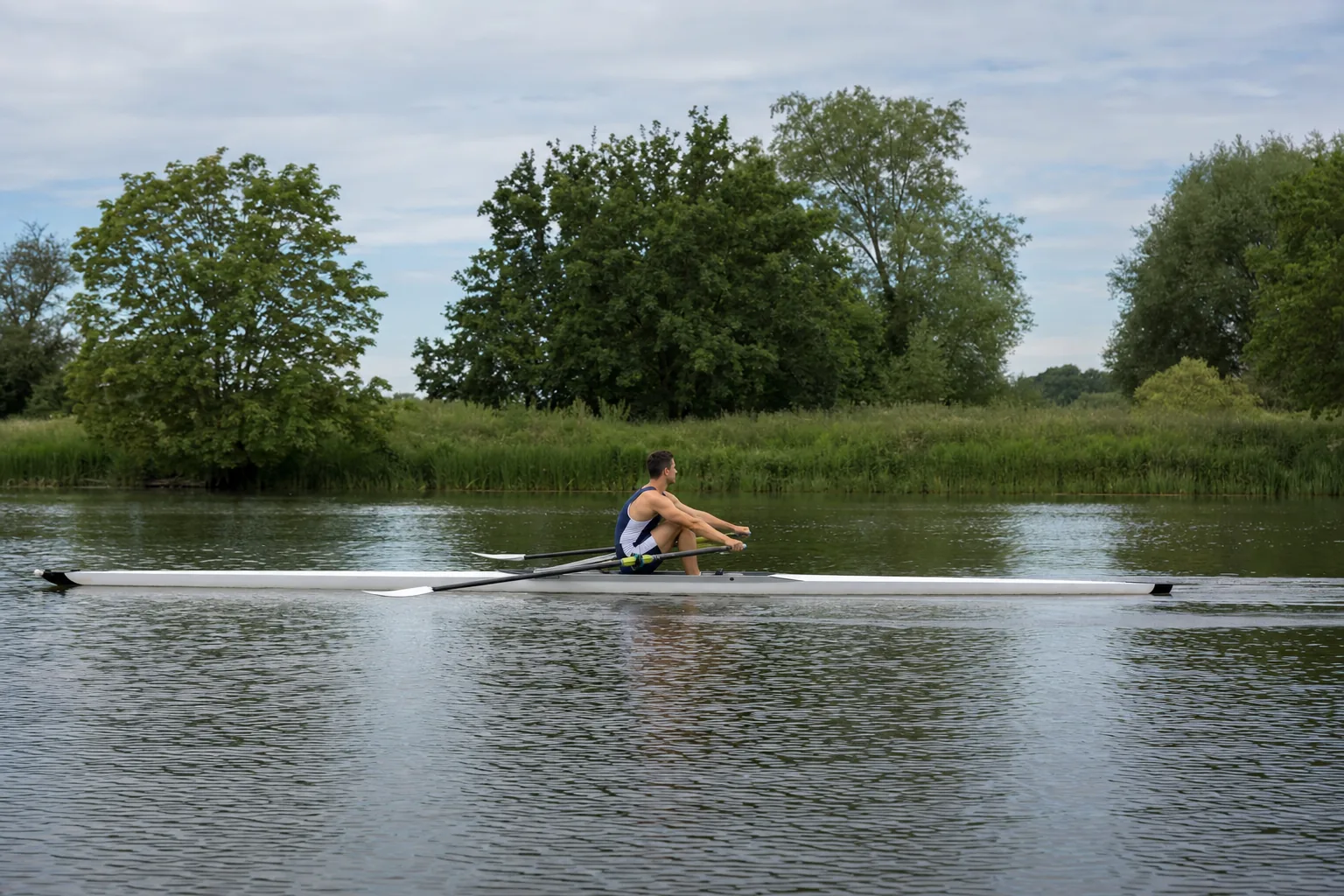
What the recovery is
The recovery is the half of the rowing stroke between strokes. The blade has just left the water at the finish. The rower needs to get back to the front stop to take the next stroke. During the slide back the rower applies no power through the spoon. The hull is gliding forward on the inertia built up during the previous drive.
Coaches sometimes call this the slide forward, the slide back, or the return. They all mean the same thing. It is the only part of the stroke that does not directly produce boat speed, and the only part where the rower is, in a sense, recovering.
Hands away, body over, slide forward
Three movements, in strict order:
- Hands away: arms extend from the body to full reach while the trunk stays in lay-back. Handle moves out, body stays where it is.
- Body over: trunk swings from lay-back through upright and on into forward body angle. The seat is still at the back stop. The body sets its catch position before the slide starts.
- Slide forward: only now does the seat start moving up the slide. The slide is patient at first and accelerates only slightly as the rower approaches the front stop.
Pace of the slide and the ratio
The recovery should always be slower than the drive. At a 20-rate UT2 paddle, the slide back takes two to three times as long as the drive itself. That is the 1:2 or 1:3 ratio. The hull has time to glide, the rower has time to set the catch position cleanly, and the boat sits flat.
Drive the rate up to a Castleconnell head-race 30 or an Irish Champs A-final 38 and the recovery shortens, but the fast crews still keep it longer than the drive. At 40-plus the ratio approaches 1:1 and the crew is in survival territory. The hallmark of a fast Irish crew is the ability to keep the recovery feeling patient at race rate. Use the stroke rate calculator to see how distance per stroke shifts as recovery time compresses.
Why slow recovery beats fast recovery
New rowers always want to rush the slide. The logic feels obvious. More strokes per minute, more boat speed. But the boat does not move during the recovery, so racing back to the catch does not produce another power stroke any faster. It just kills the run.
A patient slide back does three useful things at once. It gives the hull time to glide, so distance per stroke goes up for the same power. It gives the leg muscles a brief rest, so the next drive is sharper. And it gives the rower time to set a clean catch position, so the front end is placed properly. Skibbereen, Commercial RC and Garda RC senior squads all reinforce this from novice intake onwards. The phrase "the recovery is when you recover" is repeated for a reason in every Irish boathouse.
Recovery faults that wreck balance
Recovery faults show up first in the run between strokes and second in the catch that follows:
- Rushing the slide: the seat starts moving before the body angle is set. The whole slide back becomes a single jerky movement. The hull surges and the catch is unsettled.
- Lurching the body: the trunk throws forward fast, often combined with a rushed slide. The boat goes off the level and the catch position is forced rather than placed.
- Slamming the front stop: the rower arrives at the front stop with too much momentum, the seat thuds against the stop, and the catch is jammed rather than placed.
- Over-reaching at the front: the rower pushes past their natural reach in search of more length. The slide goes past full compression and the rower loses purchase at the catch.
Drills that build a patient slide
Pause drills are the central tool. Pause at hands-away (one to two seconds with the arms extended and the body still in lay-back) trains the first phase. Pause at body-over (one to two seconds with the body angle set and the seat still at the back stop) trains the second phase. Run both into a continuous stroke and the recovery sequence becomes muscle memory. Square-blade rowing layered on top makes feathering faults impossible to hide, which in turn forces a cleaner finish and a calmer slide back. UCD, Trinity and the NRC squads run these as standard through every winter base block.
Recovery FAQs
What is the recovery in rowing?
The recovery is the non-propulsive half of the rowing stroke. The blade is out of the water, the rower extends the arms back to full reach, swings the body forward, and slides up the seat to set up the next catch. No power is going through the spoon. The hull glides forward on inertia from the previous drive.
What is the recovery sequence?
Hands away, body over, slide forward. In that order, every time. Arms extend back to straight while the rower stays in lay-back. The trunk then swings from lay-back through to forward body angle while the seat stays at the back stop. Only once the body is set does the seat begin to slide up to the front stop. Reverse the order, push the slide before the body is set, and the boat lurches and the catch is rushed. Coaches at every Irish club call that "lurching" or "rushing the slide".
Why is a slow recovery faster than a fast one?
Boat speed comes entirely from the drive. The recovery does not move the boat. So rushing back to the front stop does not produce another power stroke any faster, it just shortens the time the hull has to glide between strokes and means the rower arrives at the catch unsettled. A patient, controlled slide lets the boat run, gives the muscles a brief rest, and means the next catch can be placed cleanly. Skibbereen, the O'Donovan brothers, Fintan McCarthy, every Olympic medal-winning boat the country has ever sent out is built on this principle.
What is the drive-recovery ratio?
At steady-state training rates (18-22 spm on a long UT2 paddle out of Inniscarra or on Lough Ree) the recovery is two to three times longer than the drive. That is a 1:2 or 1:3 ratio. At regatta race rate (36-40 spm) the recovery shortens dramatically and the ratio approaches 1:1. Crews that hang onto recovery length at high rate have better boat run than crews that collapse it. The hull glides further between strokes for the same heart rate.
How do you train a controlled recovery?
Pause drills, pause drills, pause drills. Pause at hands-away (after the arms extend, before the body swings), then pause at body-over (after the body is set, before the slide moves). One or two seconds at each pause. The drill forces the rower to sequence the recovery rather than blur it into one movement. Square-blade rowing also helps because feathering errors become obvious when there is no feather to do. NUIG, Trinity and UCC all run these in the first hour of every winter technique outing.
Related
The Drive: The Propulsive Half of the Stroke
The drive is the propulsive half of the stroke. Blade buried, legs first, back next, arms last. This is the only half th...
The Catch: Blade Entry at the Front of the Stroke
The catch is the split-second of blade entry at the front end of the slide, before the legs start to push. Get the blade...
The Finish: Clean Blade Extraction
The finish is the back-end moment when the blade comes cleanly out of the water and the stroke hands off into the recove...
Stroke Rate: Strokes Per Minute Cadence
Stroke rate is the cadence of strokes per minute a crew rows. Anywhere from 18 on a long base paddle on Lough Ree to 44...
Keep learning
Work on a patient recovery should not disappear when another coach takes the crew. Row HQ keeps the cue against the rower and carries it into the next outing. Move through the rest of the stroke in the rowing glossary.
Stop reminding the same rowers to slow the slide every Tuesday.
Row HQ logs recovery-pace notes against the rower they belong to, so a fault flagged at NRC on Saturday is still in the system when the squad gets out on the Lee on Tuesday morning.