Drive
The drive is the leg-back-arm push that runs from the moment the spoon is buried at the catch through to the body at the finish. Legs first while the back stays forward and the arms stay long, then the back opens, then the arms finish the stroke into the lower ribs. It is the only phase that produces hull speed - the rest of the stroke just sets the next one up.
The Drive: The Only Phase That Moves the Boat
The drive is the propulsive section of the rowing stroke that runs from the moment the spoon is buried through to the moment it leaves the water at the body. Power flows in the legs-back-arms order. Peak force happens early when the hull is moving slowest and the blade has most to lever against. The recovery is non-propulsive; the drive does every metre of work. Drive-to-recovery time ratio sits near 1:2 or 1:3 at training rates and closes toward 1:1 once a crew reaches King's Cup race pace.
Also called: Drive Phase, Power Phase
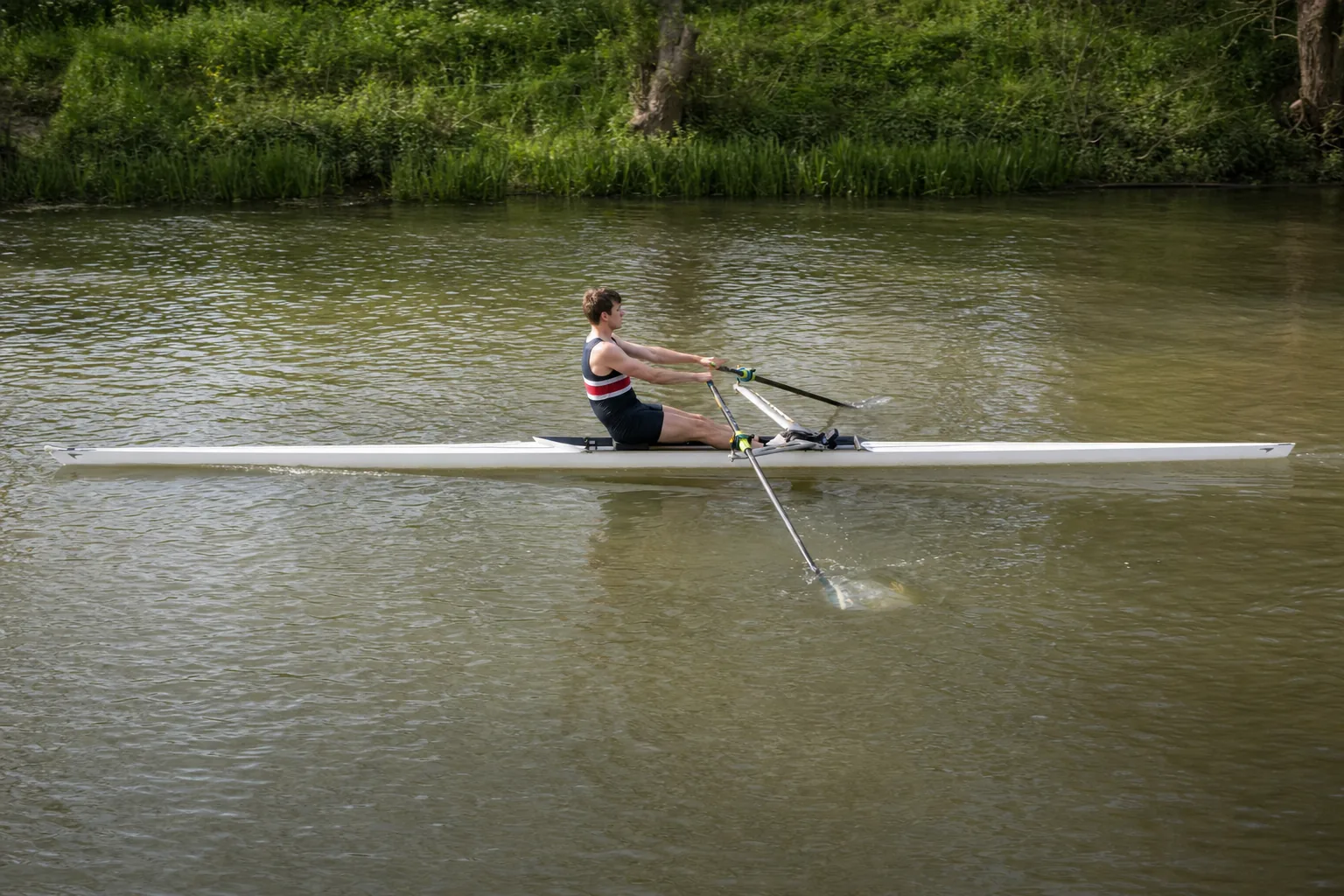
What the drive is
The drive is the work half of the rowing stroke. It begins the instant the spoon is buried at the catch and ends the moment the blade leaves the water at the finish. The rower loads the foot stretchers, leg force drives through the seat and into the back, the back transmits it into the arms, and the arms transmit it into the handle. The handle moves the spoon, the spoon levers against the water, and the water pushes the boat past the spoon.
The drive does every metre of work in the stroke. The recovery is non-propulsive - the hull keeps moving by inertia from the previous drive while the rower resets into the next catch position. Every metre on the Yarra, Lake Barrington or the Penrith course is generated here.
The leg-back-arm order
The drive sequence runs legs, then back, then arms, in that order:
- Legs: the legs go first, loading the foot stretchers and driving the seat sternward. The back stays in body-over position and the arms stay long. The handle moves toward the body purely on the leg push.
- Back: as the legs near full extension, the back unwinds from forward body angle through vertical and on into the lay-back. The seat is now decelerating and the back picks up the load.
- Arms: only at the back end of the stroke do the arms break - elbows draw past the body, hands finish at the lower ribcage, wrists stay flat.
Opening the back early or breaking the arms before the legs are done is the most common drive fault in Aussie shed work. The legs are the strongest muscles in the body and need to do the heaviest lifting. The back is the bridge, the arms are the connection - get the order wrong and the strongest muscles work against the weakest.
Front-loaded power profile
Force should peak in the first third of the drive when the legs are still loaded and the back has just started to open. This is the front-loaded profile every Aussie programme chases. The blade gets its strongest hold on the water at the catch because the hull is moving slowest there, so heavy force early translates directly into hull acceleration. Force tapers through the middle as the boat speeds up, and the arms only need to keep the connection live through to the finish.
Beginners and unconditioned rowers default to a back-loaded profile - hardest pull at the body, lightest at the catch. The boat is already moving fast at that point so the spoon has less to lever against and the late effort produces less acceleration. Squads with instrumented oarlocks (Empower per-oar systems, BAT logic on the rigger) show rowers their force curve session by session, which is faster than coaching the feel from the bank.
Drive-to-recovery time ratio
The drive-recovery ratio is how the seconds inside one full stroke are split between the work half and the slide half. The two are not equal. At training rates of 18 to 22 the recovery takes two to three times as long as the drive, giving the hull plenty of glide between strokes. At regatta race rate of 36 to 40 the recovery time compresses hard and the ratio approaches 1:1 - drive and recovery take roughly the same time.
Crews that hold a long recovery as the rate climbs are the crews that hold seats in the third 500 of a 2km. Rushed recoveries under race pressure scrub hull speed at exactly the wrong moment. Run a target split through the ergometer pace tool to see watt output, and most modern monitors and Coxmate GPS units show drive and recovery time separately so the ratio is visible live during pieces.
The four drive faults that get retired fastest
The drive is where speed is made and lost. The four faults below cost the most boat speed and are the first ones Aussie coaches address in junior and open squads alike:
- Shooting the slide: the legs straighten before the back has loaded. The seat moves but the handle does not, so leg force leaks away.
- Back opening early: the back starts unwinding while the legs are still pushing. Legs and back fight each other instead of running in sequence.
- Early arm break: the elbows bend while the legs are still going. Straight arms are the lever between body and handle; bending them early collapses the lever.
- Back-loaded power: the rower pulls hardest at the body. The boat is already running fast so the spoon has less to bite, and the effort produces less hull speed than the same force applied at the catch.
How the drive holds at different rates
The drive itself does not change much between rates. The leg-back-arm sequence and the front-loaded force profile stay constant whether the crew is rating 18 on a UT2 paddle or 38 in a King's Cup heat. What changes around it is the recovery: longer at low rate, compressed at race rate. Aussie programmes run rate ladders (5 minutes at 18, 5 at 20, 5 at 22, 5 at 24 and so on) so the same drive shape becomes automatic at every rate the squad uses, from the easiest steady state through to the highest sprint rate the crew will ever touch.
Drive FAQs
What is the drive in a rowing stroke?
The drive is the propulsive half of the stroke - the section between blade entry at the catch and blade exit at the finish. It is the only part of the stroke that moves the hull forward; the recovery is just the slide back into position. Every metre of boat speed is produced here, which is why coaches at AIS, NSWIS and the King's Cup squad break the drive down into checkpoints rather than coaching it as one big push.
What does the leg-back-arm sequence mean?
The drive runs in the order legs, back, arms. The legs push the foot stretchers and drive the seat sternward while the back stays forward and the arms stay long. The back then unwinds from the body-over position through to lay-back as the legs near full extension. The arms only bend once everything else is finished, drawing the handle into the lower ribs. Opening the back early or pulling with the arms before the legs are done is the most common fault Aussie coaches retire in junior squads.
Where does peak power happen during the drive?
Peak force happens in the first third of the drive, when the legs are still loaded and the back has just started to open. This front-loaded profile is what every Aussie squad chases because the blade has the strongest hold on the water when the hull is moving slowest. Beginners typically produce a back-loaded profile - hardest pull at the body - which is less efficient because the blade has less to bite against as the boat picks up speed. Instrumented oarlocks (Empower, BAT logic) let coaches show the force curve to rowers in real numbers rather than guessing from the bank.
How is the drive-recovery ratio different from stroke rate?
Stroke rate is how many strokes per minute the crew rates. The drive-recovery ratio is how the time inside one stroke is split between the work half and the slide half. At a UT2 18 to 20 the recovery typically takes two to three times as long as the drive (1:2 or 1:3). At regatta race rate of 36 to 40 the recovery shortens hard and the ratio drifts toward 1:1. The mark of a fast crew is keeping the recovery as long as physics will allow even when the rate climbs - rushed slides under pressure are how crews drop seats in the third 500.
What does shooting the slide mean in Aussie boatsheds?
Shooting the slide (sometimes called "shoot the bum" or "leg-and-leave-it") is the fault where the legs straighten before the back joins the drive. The seat slides sternward but the handle does not move with it, so leg power leaks out as the body angle opens later than it should. Visible from a follow boat as the seat moving faster than the boat handle. Costs power on every stroke, looks ugly under video review, and gets coached out of junior squads before it sets as a habit.
Related
The Catch: Blade Entry at the Front of the Slide
The catch is the front-of-slide moment where the spoon drops from above the water to fully buried. Shins go vertical, th...
The Finish: Lifting the Blade Cleanly at the Body
The finish is the back-end transition where the spoon lifts cleanly out of the water at the lower ribs and the drive han...
The Recovery: Patient Slide Forward Between Strokes
The recovery is the slide forward between strokes - the section of the stroke cycle that runs from blade exit at the fin...
Stroke Rate: Cadence in Strokes per Minute
Stroke rate is the cadence of the rowing stroke in strokes per minute (spm). Aussie training bands run 18 to 22 for stea...
Keep learning
A strong drive depends on crew timing as much as individual power. Row HQ's rowing club software keeps outing notes and rate work tied to each rower, and the rowing glossary sets out the phases coaches refer to on the pontoon.
Drive technique work that compounds across the season.
Row HQ pairs session planning, coach notes and ergometer integration so the drive faults you log on Monday are reinforced through Friday and rolled into selection-night decisions, not forgotten in a coaches' WhatsApp thread.