Recovery
The recovery is the controlled slide back to the next catch. It produces no hull speed - the boat runs on inertia from the previous drive while the rower resets. Canadian coaches treat it as recovery time in the literal sense: the only window in the stroke cycle where the muscles get a brief rest.
The Recovery in Rowing
The recovery is the non-propulsive half of the rowing stroke, running from the release at the finish back up to the next catch. The rower extends the arms forward, swings the trunk forward from layback, then slides up the rails to the front stop. No force is applied to the blade during the recovery - the hull continues forward on the inertia generated by the previous drive. Canadian and NCCP coach education materials describe the recovery as recovery time in the literal sense: the only window in the stroke cycle where the rower's muscles get a brief rest before the next drive.
Also called: Recovery Phase, Slide Forward
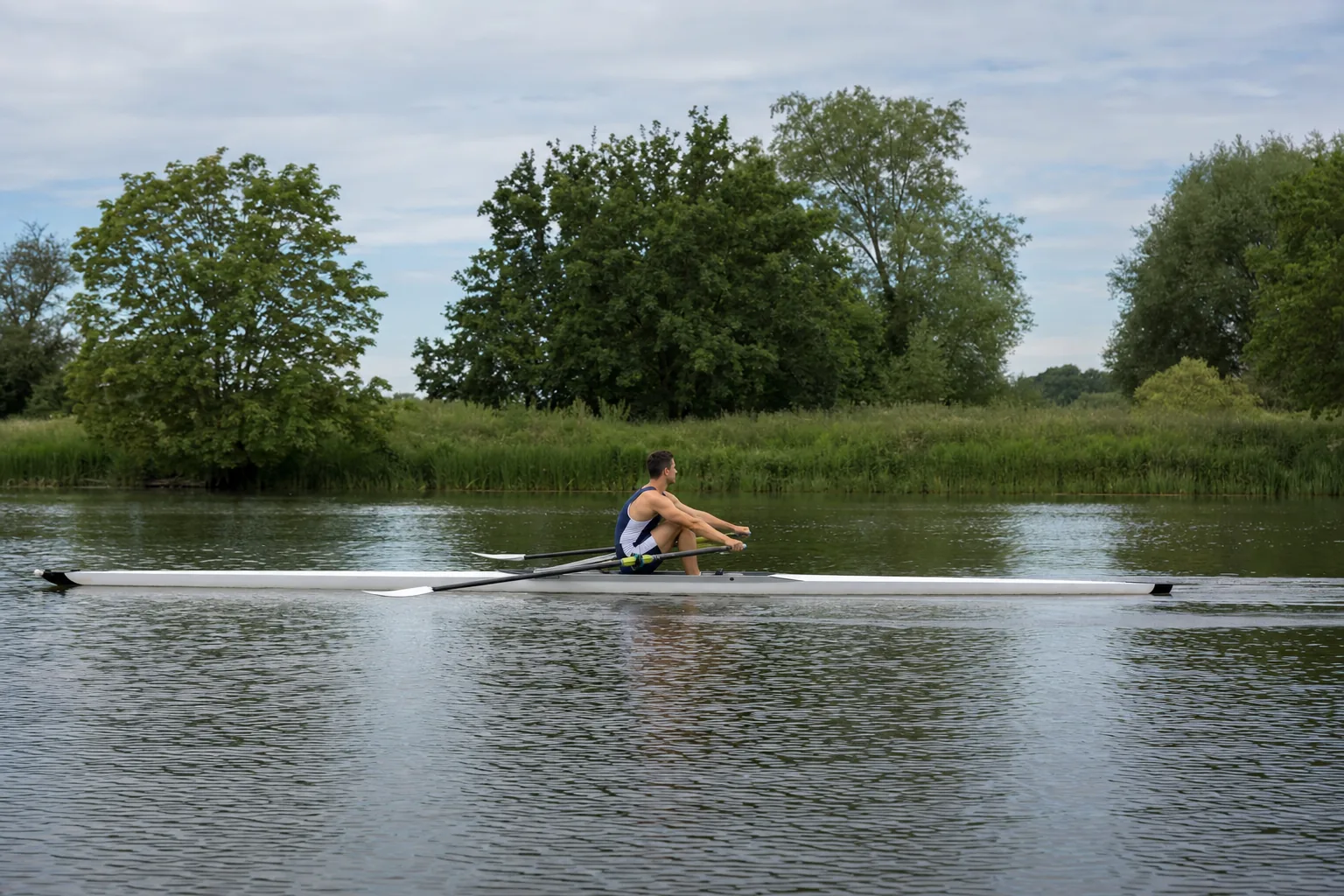
What the recovery does
The recovery is the half of the stroke that happens between drives. The blade has just lifted clear of the water at the release, and the rower needs to reset into the next catch position before they can take another stroke. The rower applies no force to the blade during this window - the hull continues forward on inertia from the previous drive.
Canadian coaching vocabulary uses the term recovery in two senses, both of them productive. It is the slide forward back to the catch, and it is also recovery time in the physiological sense - the only window in the stroke cycle where the rower's muscles get a brief rest before the next drive engages. NCCP coach education materials make the second meaning explicit.
The hands-body-slide sequence
The recovery sequence is hands away, body forward, slide forward - in that order:
- Hands away: the arms extend the handle forward while the rower holds the layback position. The handle moves away from the body until the arms are fully extended.
- Body forward: the trunk swings forward from layback through vertical and on into the forward body angle, with the seat staying at the back stop throughout this stage.
- Slide forward: only after the trunk angle is fully set does the rower begin to travel up the rails toward the front stop. The slide is gradual and accelerates only near the front of the rails as the rower approaches the catch.
Recovery pace and ratio
The recovery should always be slower than the drive. At Canadian UT2 rates of 18 to 22 spm the recovery is two to three times longer than the drive - a 1:2 or 1:3 ratio. The hull has plenty of time to glide between strokes and the rower has plenty of time to set up the next catch in balance.
At race pace in the 36 to 40 spm band the recovery compresses sharply and the ratio approaches 1:1. Holding a long, controlled recovery at race rate is one of the consistent markers of a fast crew - a Royal Canadian Henley eight that protects ratio at 38 spm is generating more distance per stroke than a crew rushing the slide at the same rate. The stroke rate calculator turns rate and split into distance per stroke, so coaches can see exactly what different recovery patterns produce.
Why a slow recovery is faster than a quick one
Beginners almost universally treat the recovery as a return trip - get back to the catch quickly so the next drive can start. The instinct makes sense and it is wrong. Boat speed comes from the drive, not from the slide back. Rushing the rails compresses the glide window, costs balance, and arrives the rower at the next catch off rhythm.
A long, controlled recovery does three productive things in parallel. It extends the time the hull spends gliding on inertia, so distance per stroke goes up. It gives the rower's muscles longer between drives, so force per stroke goes up. And it lets the rower place the next catch cleanly because they arrive at the front stop in balance. All three compound across hundreds of strokes. The Canadian coaching phrase is "ratio over rate" - and the recovery is recovery in both senses of the word.
Common recovery faults in Canadian crews
The recovery is the most coached part of the stroke at the Canadian club level because errors here cost balance and rhythm:
- Rushing the slide: the rower starts to slide before the trunk angle is set. The recovery collapses into one jerky movement instead of a sequenced three-part action. The hull surges, the catch is off balance.
- Lurching the body: the trunk is thrown forward fast, often combined with rushing the slide. The hull destabilises and the catch position arrives in a panic.
- Hitting the front stop: the rower carries too much momentum into the front stop and the seat slams against the bumper. The catch is jammed rather than smooth and the timing of the entry suffers.
- Over-reaching at the front: the rower tries to extend past the natural catch position to chase extra reach. The slide goes past full compression, the lever advantage at the catch is lost, and the entry comes in late.
Recovery drills used across Canadian programs
Pause drills are the standard tool used at almost every Canadian club. Pause-at-hands-away (one to two seconds after the arms extend, before the trunk swings forward) trains the hands-away phase as a deliberate movement rather than a blur. Pause-at-body-over (one to two seconds after the trunk angle is set, before the slide starts) trains the body-forward phase the same way. Both drills force the rower to sequence the recovery in three distinct movements rather than blending them into one. Square-blade rowing also trains a controlled recovery because feathering errors are obvious when the blade stays square - the boat sets the rower up rather than the rower setting the boat up. Brentwood, St Catharines RC and Hanlan all build pause work into morning warm-ups.
Recovery FAQs
What is the recovery in rowing?
The recovery is the non-propulsive half of the stroke, running from the release at the finish back up to the next catch at the front stop. The rower extends the arms forward, swings the trunk forward from layback, then slides up the rails toward the next entry. The hull continues forward on the inertia generated by the previous drive, but the rower applies no force to the blade during this phase. In NCCP coach education materials the recovery is taught explicitly as recovery time - the only window in the stroke cycle where the rower's muscles get a brief rest before the next drive.
What is the recovery sequence Canadian coaches teach?
Hands away, body forward, slide forward - in that order. The arms extend the handle forward first while the rower stays in the layback position. Then the trunk swings forward from layback to the forward body angle, with the seat staying anchored at the back stop. Only once the body angle is fully set does the rower start to move up the rails. Reversing the order - sliding before the trunk is set, or rushing the body swing - is the fault Canadian coaches call rushing the slide or lurching. It destabilises the hull and arrives the rower at the catch off balance.
Why is a slow recovery faster than a quick one?
Boat speed comes from the drive. The recovery is where the hull glides on inertia and the rower resets for the next stroke. Rushing the slide back to the front stop does not add hull speed - it just shortens the glide window and arrives the rower at the next catch in a panic. A long, controlled recovery does three productive things at once: the hull has more time to run on inertia so distance per stroke goes up, the rower's muscles get longer between drives so force per stroke goes up, and the catch sets up cleanly because the rower arrives at the front stop in balance. The phrase Canadian coaches repeat is "ratio over rate" - the patient recovery is almost always the faster one.
What is the drive-to-recovery ratio at different rates?
At UT2 steady-state rates of 18 to 22 spm the recovery is two to three times longer than the drive, so the ratio sits around 1:2 or 1:3 and the hull has plenty of time to glide. At Canadian race pace in the 36 to 40 spm band the recovery compresses sharply and the ratio approaches 1:1 - drive and recovery take roughly the same time. A Royal Canadian Henley eight that can hold a long, controlled recovery at 38 spm is faster than a crew rushing the slide at the same rate, because it generates more distance per stroke for the same number of strokes per minute.
Which drills build a controlled recovery?
Pause drills are the standard tool used at almost every Canadian club. The rower pauses for one or two seconds at hands-away (after the arms extend, before the trunk swings) and again at body-over (after the trunk angle is set, before the slide starts). Both pauses isolate the sequence and remove the rush. Square-blade rowing also trains a controlled recovery because feathering errors are obvious when the blade stays square, and the boat sets the rower up rather than the rower setting the boat up. Brentwood, St Catharines RC and Hanlan Rowing Club all build pause work into morning warm-ups as standard practice.
Related
The Drive in Rowing
The drive is the propulsive half of the rowing stroke, running from catch entry to release at the finish. Canadian coach...
The Catch in Rowing
The catch is the single instant a square blade buries at the front of the stroke cycle. In Canadian rowing it draws more...
The Finish in Rowing
The finish is the back end of the drive - the tap-down release at the body that bridges drive into recovery. A clean rel...
Stroke Rate Explained
Stroke rate is the rating a crew holds, measured in strokes per minute. Canadian rating bands run from 18 spm on a UT2 w...
Keep learning
Consistent recovery cues matter when several coaches share a crew. Row HQ records each athlete's technique notes so the same fault is not diagnosed again at the next practice. Read the rowing glossary for the other parts of the stroke.
Stop calling "slow the slide" every outing.
Row HQ's coach tools log technique notes against each rower across sessions, so the recovery work you put in on Tuesday is still in the system for Saturday's assistant coach.