Stroke Seat
Stroke is the rower at the stern end of the boat - the seat closest to the coxswain in coxed crews. The whole boat times off stroke's blade. Every catch, every drive, every recovery is matched to whatever stroke is doing. In an eight, stroke is seat 8. In a four, seat 4. In a pair, the stern rower. In a sculling crew, the rower whose feet point away from the bow ball.
What is the Stroke Seat?
The stroke seat is the rower at the stern end of a rowing shell - the position closest to the coxswain in coxed boats. Stroke sets the rate and rhythm that every other rower in the crew matches. In an eight this is seat 8; in a four, seat 4; in a pair, the stern rower; in a sculling crew, the rower nearest the stern.
Also called: Stroke, Stroke Position, Stern Pair
The role of the stroke seat
Stroke owns the rhythm of the boat, full stop. Every rower behind stroke synchronises catch, drive, finish and recovery to whatever stroke does. A stroke who is consistent and clean gives the crew something stable to lock onto - the rest of the boat can focus on length, power and connection without thinking about timing. A stroke who rushes the slide or skips at the catch breaks the entire crew's timing within a few strokes.
Race calls flow through stroke. When a coxswain at the Royal Canadian Henley calls a rate push heading into the grandstands, or a CSSRA crew's cox calls a power 10 off a competing school, stroke is the first link in the response. Stroke commits to the call, 7 picks it up, and the move propagates through the boat to bow. Without stroke executing cleanly, the call dies before it reaches the engine room.
Coxless boats - the pair, the coxless four, every sculling boat without a cox - hand stroke the tactical role on top of the rhythm role. There is no cox watching the opposition or calling the race plan, so stroke does that work themselves. Many Canadian coaches build their crew lineups by choosing stroke first, then assembling rowers who fit cleanly around that decision. Crew selection tools in modern club software make it easier to test combinations and track how a chosen stroke performs against different supporting casts.
How stroke seats are selected
Canadian coaches typically settle stroke early in the crew selection process. The standard criteria:
- Technical consistency: stroke length and rhythm that the rest of the crew can reliably mirror.
- Racing composure: the ability to land called rate changes cleanly under pressure without grabbing or rushing.
- Rhythm instinct: a feel for the cadence at which this particular crew runs fastest.
- Endurance base: stroke seats often carry slightly higher effective load because the crew paces to them rather than the other way round.
The fastest 2k erg score in a Canadian squad does not always go to stroke. Stroke is a rhythm and racing role as much as a power role. Some Canadian coaches put their biggest erg numbers at 5 or 6 in the engine room where raw watts apply most directly to boat run, and place a technically cleaner rower with strong racing instincts at stroke. Selection logic differs from program to program - OUA squads at Western or Brock may prioritise racing experience, while a development crew at the same school might pick the steadiest pair of hands available.
The stroke pair
In an eight, seats 7 and 8 form the stroke pair. Stroke sets the cadence; 7 picks it up immediately and transmits it back through the engine room. The connection between 7 and stroke is one of the highest-impact relationships in any rowing boat - if those two seats are even half a beat apart, the rest of the crew is fighting a battle that cannot be won. Most coaches treat stroke and 7 as a unit, not as two separate seats.
Canadian university programs at the OUA and U SPORTS level, and competitive club programs from Argonaut and Hanlan in Toronto through to Brentwood College on Vancouver Island, often fix the 7-stroke pairing for the entire season. The two rowers train together every outing, develop shared instincts for timing and pace, and become the rhythm core that the rest of the crew assembles around. The 3-4 pairing plays the same role in a coxed or coxless four.
Stroke seat in sweep vs sculling
Sweep boats give the coach a rigging choice for stroke: stroke-side or bow-side. The choice changes how the cox's steering line works and how the riggers distribute load down the boat. The default in a coxed eight across most Canadian boathouses is stroke-side rigging - stroke's oar on the left as you sit in the boat facing the stern - but Italian rigging variants exist and appear occasionally at the senior national team level.
Sculling boats remove the rigging-side decision entirely. The stroke seat is simply the rower nearest the stern and the rest of the boat follows that blade. In a double scull, the stern rower takes stroke by convention for whichever outing is happening. Quad sculls racing at the Royal Canadian Henley typically settle on a designated stroke for the full season so the crew can build the same fixed pairings that an eight relies on.
Famous stroke seats
Some of rowing's most decorated names built their reputations from the stroke seat. Sir Steve Redgrave stroked the British coxless four to Olympic gold in both 1996 and 2000. Mahe Drysdale ruled the single sculls from the stroke position through multiple Olympic and World Championship cycles. Canada has placed racing intelligence at stroke at the international level for decades - the seat where coaches put the rower they trust most to manage a race plan from the start signal through the finish-line sprint at venues from Lake Banook to the Olympic course at Aiguebelette. The pattern holds at club level too: at any major Canadian regatta, the stroke seats in the senior eights are usually the rowers with the deepest racing CVs in the boathouse.
How stroke seats train differently
Stroke seats follow the same training programme as the rest of the crew but with more focus on rate accuracy, pacing rehearsals and race-piece work. Training session plans often include rate ladders (rowing at 18, 20, 22 and 24 spm in sequence) and rate-change drills where stroke must hit and hold a called rate exactly. Race rehearsal pieces from a rolling start at full intensity are central to stroke seat preparation through fall trial season and into the spring sprint block.
A cox box (NK CoxBox or Coxmate GPS) gives stroke real-time rate feedback in training. Stroke uses that feedback to learn what each target rate feels like in the body - so when a cox calls 38 at Henley Island or at the OUA Championship at Fanshawe Lake in London, stroke can find the rate and hold it without staring at a display.
Origin of the term
The phrase 'stroke seat' traces to 19th-century English rowing. 'Stroke' originally referred to the act of pulling the oar through the water. The rower at the stern, whose stroke the others followed, came to be known as the stroke - and the seat took the name with it. The term carried with the sport as it spread internationally; Canadian, American, Australian, German and Italian rowing all use direct equivalents of 'stroke' for the same position in the boat.
Stroke seat FAQs
What does the stroke seat do?
Stroke owns the rate and the rhythm. Every rower behind stroke watches the blade and handle through every stroke and matches the timing exactly. When the coxswain calls a move - a rate push for the grandstands at Martindale Pond, a power 10 to walk through a competitor at the OUA Championship - stroke is the first link in the chain. The call goes from cox to stroke, stroke executes, and the rest of the crew follows in sequence back to bow. In coxless boats, stroke also carries the tactical role: reading the race, judging when to spend energy and when to hold.
What is the difference between stroke seat and bow seat?
Stroke sits at the stern end of the boat, closest to the coxswain in coxed crews. Bow sits at the opposite end, furthest from the cox, and is the rower whose seat crosses the finish line first - the finish-line camera reads bow ball. The two ends serve different functions: stroke is the rhythm engine, bow is typically a technically clean rower whose blade work at the lightest end of the hull preserves boat run. In coxless pairs and fours, bow also handles steering through a foot-operated rudder linkage.
What makes a good stroke seat?
Three qualities matter. First, technical consistency - a stroke length and rhythm the crew can lock onto with confidence. Second, racing composure - the ability to execute a called rate change cleanly without rushing, stiffening or grabbing at the water. Third, rhythm sense - feel for the boat's natural cadence and the rate at which this particular crew runs fastest. Canadian coaches at clubs racing into the Royal Canadian Henley or the CSSRA Championships typically pick their most experienced racer for stroke, not necessarily the rower with the best 2k erg score. Stroke is a rhythm and racing role, not purely a power role.
What is the stroke pair?
In an eight, the stroke pair is seats 7 and 8. Stroke sets the rhythm; 7 picks it up immediately and amplifies it back through the engine room (seats 3, 4, 5, 6) to bow pair (1, 2). A mismatch between 7 and stroke breaks the boat's run faster than any other timing problem - the two seats need to be in absolute synchrony. Canadian coaches at OUA programs like Western, Brock and Trent often keep a trusted 7-stroke pairing together across an entire season, training together every outing so the timing becomes instinctive. In a four (4+ or 4-), the equivalent is the 3-4 pairing.
Is the stroke seat different in sweep vs sculling?
In sculling boats - single, double, quad, octuple - stroke is simply the rower nearest the stern, and the crew times off that blade. There are no rigging-side decisions to make because sculling boats are rigged symmetrically. In sweep boats, stroke can be rigged either stroke-side or bow-side depending on the crew configuration, and the choice affects how the cox's steering line works. Stroke-side rigging (left as you face the stern from inside the boat) is the convention for a coxed eight in most Canadian boathouses, but Italian rigging variants appear occasionally at the national team level.
Related
The Coxswain
The coxswain is the non-rowing crew member who sits in a coxed shell to steer, call rate and direct race strategy. The c...
Stroke Rate Explained
Stroke rate is the rating a crew holds, measured in strokes per minute. Canadian rating bands run from 18 spm on a UT2 w...
What is a Head Race?
A head race is a rolling time trial. Crews launch one at a time, race the clock over 4 to 6 kilometres of river, and the...
What is a Regatta?
A regatta is the sprint format of competitive rowing. Six lanes, a buoyed 2,000m course, all crews launched off the line...
Rowing Boat Types
Eight racing shell classes are contested at Canadian regattas: the single (1x), double (2x), pair (2-), quad (4x), coxle...
From the RowHQ shop
Printable PDFs written for club rowers. Buy once, keep forever.
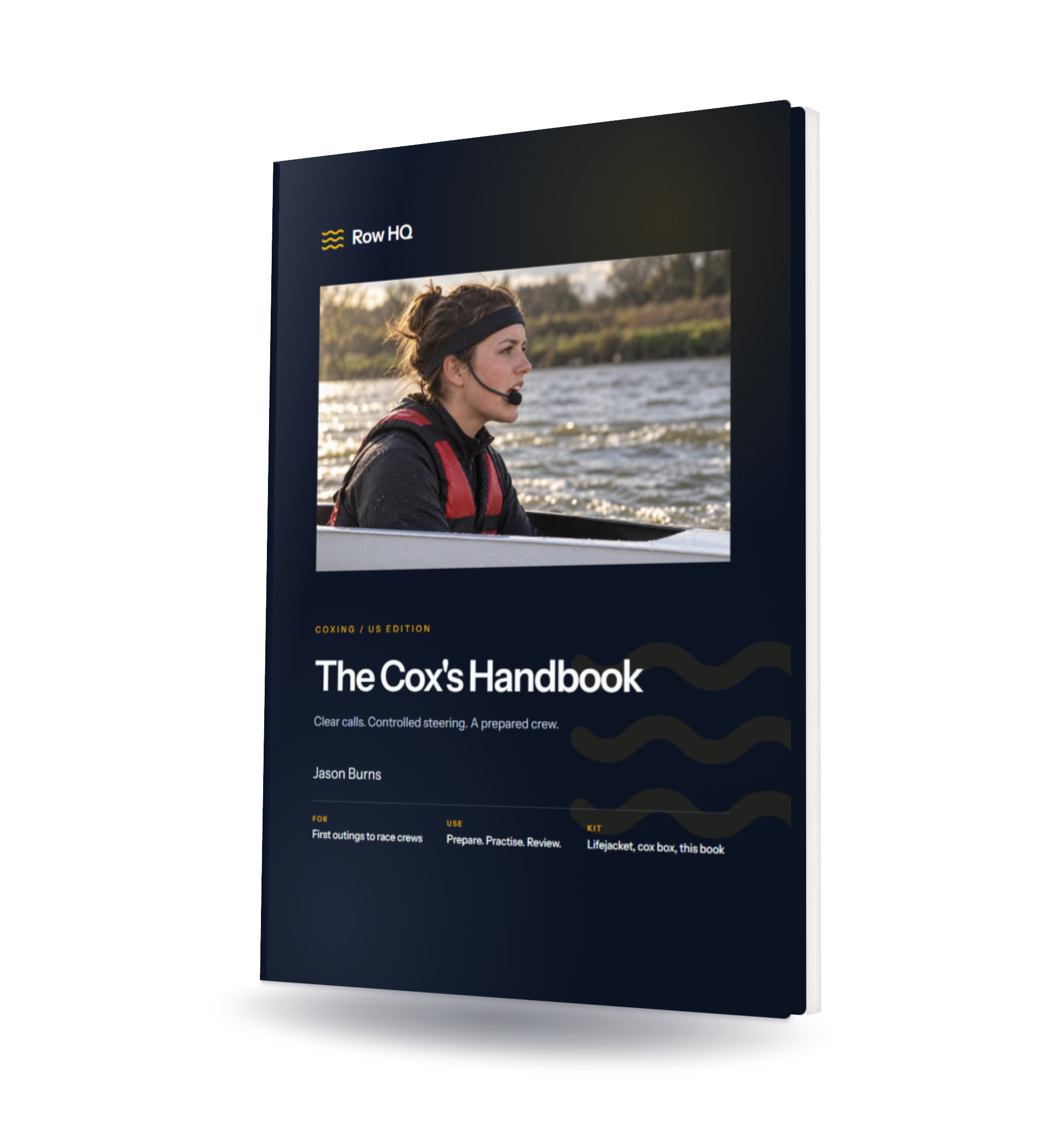
The Cox's Handbook
Practical calls, steering, session drills and race plans for new and improving coxes. Includes five printable worksheets.
The Club Session Library
52 rowing sessions for club coaches, with an illustrated coaching PDF, editable CSV plans, two seasonal blocks and a printable coaching cheat sheet.
Keep learning
Picking stroke is usually the first lineup decision, not the last. Row HQ records the seats and availability behind that choice. Use the rowing glossary to check the terms that shape the rest of the boat.
Picking a stroke seat is a coach call. Building the crew shouldn't be admin.
Row HQ's coach tools handle crew lineups, rower availability and seat assignments in one view. Built by rowers, for rowing clubs.