Drive
The drive is the propulsive half of the stroke. Blade buried, legs first, back next, arms last. This is the only half that produces boat speed. Skibbereen built three Olympic medals on a long, patient version of it.
The Drive: The Propulsive Half of the Stroke
The drive is the propulsive half of the rowing stroke. Blade buried, legs firing first, back opening through the middle, arms drawing the handle in at the back end. This is the only phase that produces boat speed. Skibbereen Rowing Club, which has produced three Olympic medals out of Fintan McCarthy and the O'Donovan brothers, is internationally known for a long, leg-anchored drive that loads up the front of the stroke and stays patient at the finish. Most Rowing Ireland coach-pathway material on the drive uses Skibbereen footage as the reference model.
Also called: Drive Phase, Power Phase
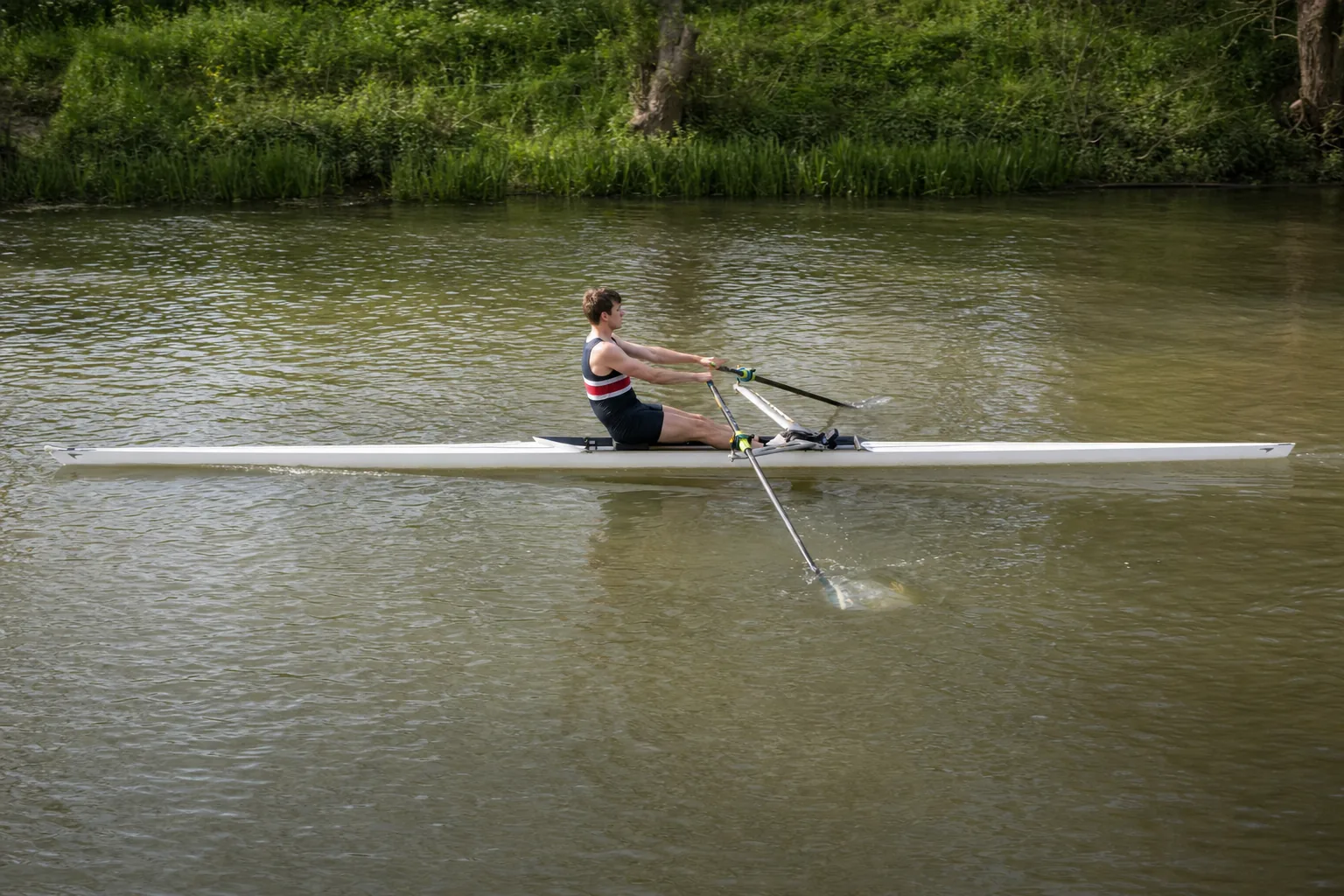
What the drive is
The drive is the half of the rowing stroke that makes the hull move. It starts the instant the blade is buried at the catch and ends the instant the blade leaves the water at the finish. The handle is connected via the rigger and pin to the spoon, and the spoon levers against the water while the body and legs push the hull past it.
Nothing on the recovery makes the boat move. The hull glides on inertia between strokes while the rower slides forward to reset. So every gram of boat speed on the GPS trace, every tenth of a 500m split, is built on the drive alone.
Leg-back-arm: the only correct order
Three body segments, fired in a strict order:
- Legs first: quads and glutes push the seat down the slide. Back stays locked at full forward body angle. Arms stay long. The handle moves toward the body purely through the slide running underneath the rower.
- Back next: as the legs near full extension, the trunk swings from forward body angle through upright and on into lay-back. This is where most of the power comes through in a senior squad.
- Arms last: only at the very end, with the legs flat and the back well into lay-back, do the elbows bend and draw the handle into the lower ribs.
Reverse this and the strongest muscles in the body work against the weakest. A Junior 16 yanking the handle with the biceps before the legs have done anything is a Junior 16 who will be five lengths down at the 1500m mark in Inniscarra. Sort the sequence first, sort everything else afterwards.
Front-loaded power: where the watts should land
The boat is moving slowest at the catch, which means the blade gets the best mechanical hold on the water at the catch. That is where peak force should be applied. As the hull accelerates through the drive, the blade has less and less to push against, so any power applied late in the stroke is partly wasted. The textbook profile is a sharp build to peak at around 30 to 40 percent of the drive, then a controlled tail off toward the finish.
Beginners do the opposite. They wind up through the drive and pull hardest at the finish, where it feels strongest but produces the least propulsion. Boats fitted with instrumented oarlocks (Active Tools Empower, BAT logic) show this clearly: the force curve peaks late, the blade is washing through, and the split is fifteen seconds off where the rower thinks it is. Skibbereen, Commercial and the senior squad at UCD all use Empower data through Irish Champs preparation to drag the peak forward into the front third of the arc.
Drive-recovery ratio across the rate range
At a 60-minute UT2 paddle around the National Rowing Centre course at 18-20 spm, the drive takes roughly a quarter of each stroke and the recovery takes the other three quarters. That is the 1:3 ratio that lets a base aerobic piece feel like a glide. Bring the rate up to 26 for an AT piece and the recovery shortens, closer to 1:2. Drive a flat-out 2k start at 44 spm and the drive and recovery occupy roughly equal time, a 1:1 ratio.
The fast crews at every Irish Champs cling on to recovery length later into the rate than the slow ones. Crews that rush the slide at 38 spm are spending the recovery scrabbling rather than gliding, the hull checks between strokes, and the splits look ugly relative to the heart rates. The Concept2 erg pace calculator converts target splits into watts, and any PM5 monitor will show drive time and recovery time separately so a coach can audit ratio off the boat as well as on it.
Drive faults you will spot from the launch
Most of the drive faults at Irish club level show up in the first 200m of any race start:
- Shooting the slide: legs straighten before the back loads. The seat races out from under the rower and the handle barely moves.
- Opening the back too early: trunk pops up while the legs still have range. Legs and back compete for the same window instead of sequencing.
- Bent arms early: elbows start to fold the moment the blade is in. Straight-arm lever advantage is thrown away and the back has nothing solid to pull against.
- Back-loaded force curve: peak power lands at the finish, where the blade has lost its hold and the watts go into spray rather than hull speed.
Why the drive stays the same as the rate climbs
The drive sequence does not change much from a 20-rate steady-state paddle to a 42-rate sprint finish. Legs first, back next, arms last, every time. What changes is the recovery. The drive should feel the same at every rate the squad uses, which is exactly why rate-ladder pieces (5 minutes at 18, then 20, then 22, then 24) are a fixture in every UCC, UCD and Garda RC winter block. The aim is for the leg-back-arm sequence to be automatic from the first stroke of a Castleconnell head-race rate-up right through to the final 20 strokes of an Irish Champs A-final.
Drive FAQs
What is the drive in rowing?
The drive is the propulsive half of the stroke, blade locked in the water, where the rower pushes the hull past the spoon. It runs from the moment the blade is buried at the catch to the moment it leaves the water at the finish. The recovery slides the rower back to the front stop with the blade in the air and produces no propulsion. Every centimetre of boat speed comes off the drive.
What is the leg-back-arm sequence?
Legs first, then back, then arms. The legs push the seat down the slide while the back stays forward and the arms stay long. The back only opens once the legs are most of the way through their range. The arms only bend at the very end, drawing the handle into the body. Reverse that order, by yanking with the arms early or popping the back open before the legs have finished, and the rower wastes the strongest muscles in the body. Bow-side and stroke-side in any UCD or Garda crew will be sorted on this sequencing before they ever line up for an Irish Champs final.
When is peak power applied?
Around the middle of the drive, when the legs are still pushing and the back is just starting to swing open. That is the front-loaded profile every Rowing Ireland coach trains for: maximum force when the hull is slowest at the catch, dropping off as the boat picks up speed. Beginners almost always have a back-loaded profile, pulling hardest at the finish. The blade has less hold on accelerating water, so that late-drive power leaves a smaller dent in the splits than it feels like it should.
What is the drive-recovery ratio?
At steady-state rates (18-22 spm during a 60-minute UT2 paddle on Lough Ree or a long base piece into Inniscarra) the recovery runs two to three times longer than the drive. That is the 1:2 or 1:3 ratio. At regatta race rate (36-40 spm) the recovery shortens dramatically and the ratio approaches 1:1. A fast crew is the one that hangs onto recovery length even at race rate. Crews that collapse the slide at high rate work harder for less hull speed.
What does shooting the slide mean?
Shooting the slide is the classic drive fault: the legs straighten before the back has loaded up. The seat shoots out from underneath the rower while the handle barely moves. From the bank or off the launch you see the seat racing the handle, and the handle losing. All the leg power is dumped into the slide, not the blade. It is the single most common drive fault at Junior 16 level in every Irish club from Neptune to UCC.
Related
The Catch: Blade Entry at the Front of the Stroke
The catch is the split-second of blade entry at the front end of the slide, before the legs start to push. Get the blade...
The Finish: Clean Blade Extraction
The finish is the back-end moment when the blade comes cleanly out of the water and the stroke hands off into the recove...
The Recovery: Slide Back with the Blade Out of the Water
The recovery is the slide back between strokes, blade out of the water, from finish to next catch. It produces no propul...
Stroke Rate: Strokes Per Minute Cadence
Stroke rate is the cadence of strokes per minute a crew rows. Anywhere from 18 on a long base paddle on Lough Ree to 44...
Keep learning
Good drive rhythm comes from repeating the same sequence under pressure. Coaches can keep each crew's technical notes in Row HQ's rowing club software and use the rowing glossary when a rower needs the phase explained plainly.
Sequence the squad as carefully as you sequence the stroke.
Row HQ rolls session plans, coach observations and erg data into one place so a winter block builds rather than scatters across a notebook, a WhatsApp thread and three spreadsheets.