Drive
The drive is the propulsive half of the rowing stroke, running from catch entry to release at the finish. Canadian coaches build it in the legs-back-arms order, front-load the force profile, and protect the recovery ratio even at race pace. Every metre of hull speed is generated here.
The Drive in Rowing
The drive is the propulsive phase of the rowing stroke, running from the catch entry through to the blade release at the finish. The Canadian and Rowing Canada Aviron standard sequence is legs first, then trunk, then arms - shorthanded by NCCP coaches as LBA. Peak hull force lands around the middle of the drive when the legs are still working and the back has just opened. The drive is the only segment of the stroke that adds boat speed. The recovery returns the rower to the next catch without applying any force.
Also called: Drive Phase, Power Phase
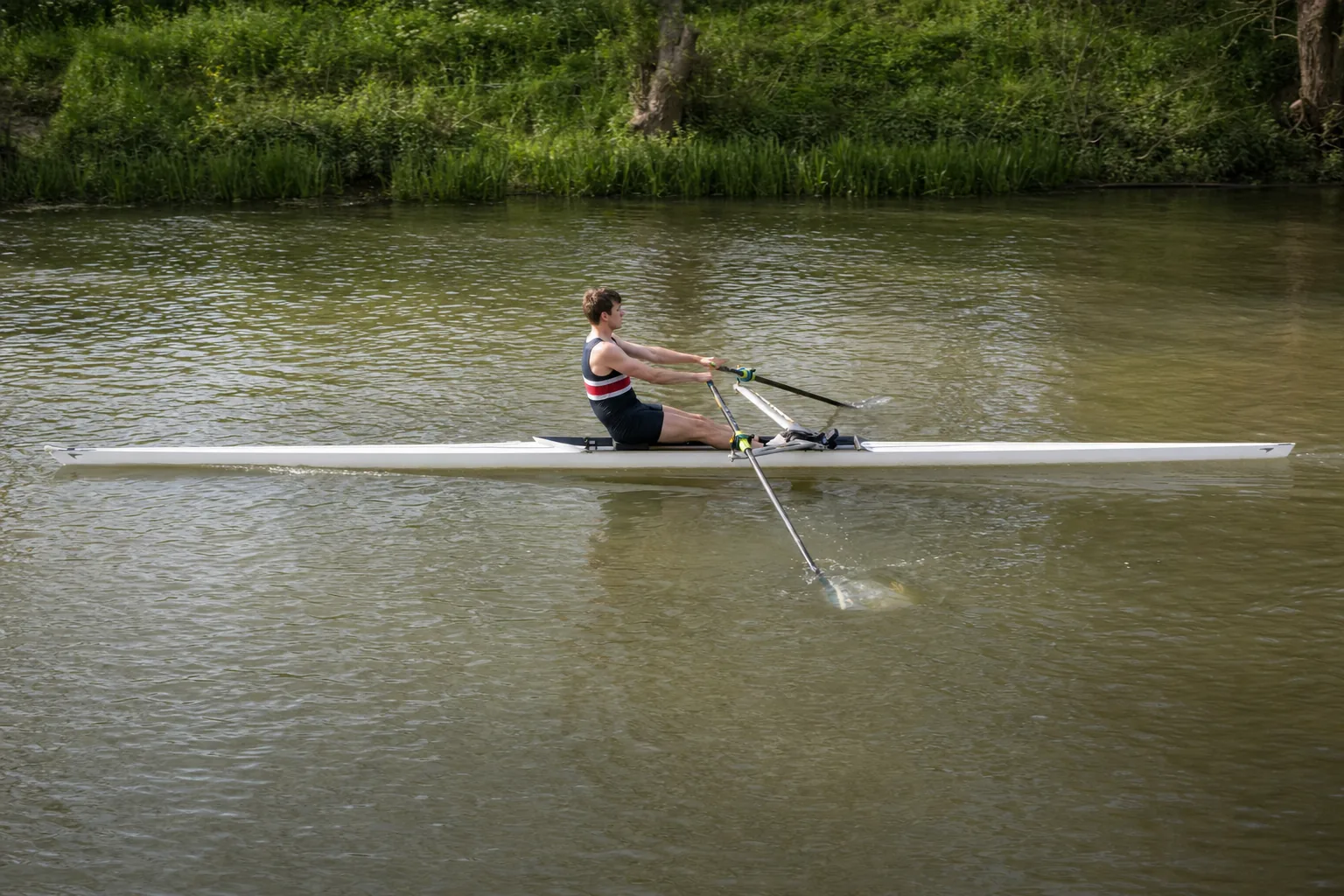
What the drive produces
The drive is the segment of the stroke that produces hull speed. It opens the instant the blade is fully buried at the catch and closes the moment the blade lifts clear of the water at the release. The rower applies force through the handle, transmits it through the rigger and pin to the loom of the oar, and the blade levers against the water to push the boat forward.
Nothing else in the stroke cycle adds speed. The recovery that follows is non-propulsive - the hull glides on inertia from the previous drive while the rower slides back up the rails to the next catch. Every metre of boat speed on a Royal Canadian Henley course, a CSSRA Championship lane or a Lake Banook morning paddle is generated during the drive.
The LBA sequence Canadian coaches teach
Rowing Canada Aviron and the NCCP coach education pathway teach the drive in a fixed order: legs, then back, then arms - usually abbreviated to LBA on whiteboards across the country:
- Legs: the legs press first while the trunk holds its forward body angle and the arms stay long. The handle moves toward the body purely on leg power for the first portion of the arc.
- Back: as the legs approach full extension, the trunk opens from forward angle through vertical and on into the layback. The leg drive is still finishing as the back swing begins, so the transition is layered rather than stepped.
- Arms: only at the closing portion of the drive do the elbows bend to draw the handle into the body for the release.
Mixing the order is the most common drive fault flagged across Canadian junior development squads. Pulling early with the arms, opening the back before the legs have done their work, or collapsing the trunk forward all break the sequence. The legs are the strongest muscle group available and must do the heaviest portion of the work. The trunk and arms finish what the legs started.
Front-loaded force profile
Force should peak in the front half of the drive, not at the release. The blade has the strongest hold on the water early in the drive because the hull is moving slowest relative to the water at that point. Applying maximum force when the blade is best held produces the most speed; applying it late, when the hull is already accelerating, returns less for the same energy.
Canadian programs increasingly read force traces on instrumented oarlocks - Empower-style systems at clubs with the budget, NK Speedcoach data overlays elsewhere - to show rowers exactly where their force lands across the drive. The fix for a back-loaded trace is almost always work on the catch entry and the leg drive sequence, not work on the finish.
Drive-to-recovery ratio at Canadian rates
The drive-to-recovery ratio is the relative time spent on the drive versus the recovery slide. At Canadian UT2 steady-state rates of 18 to 22 spm the recovery is two to three times longer than the drive - a 1:2 or 1:3 ratio. The hull has plenty of time to glide between strokes and the rower has plenty of time to set up the next catch in balance.
As the rate climbs toward race pace at 36 to 40 spm, the recovery compresses sharply and the ratio approaches 1:1. Drive and recovery take roughly the same time. The Canadian crews that hold a long, controlled recovery at race rate generate more distance per stroke than crews that rush the slide and arrive at the next catch off balance. The erg pace calculator converts split into power and back, so a coach can size the ratio question against actual work output rather than guess.
Common drive faults in Canadian crews
Most of the boat speed lost or saved in a stroke happens during the drive. The recurring faults across Canadian club and university programs are:
- Shooting the slide: the legs straighten before the trunk engages, the seat moves back without the handle, and leg power is spent without transferring to the blade.
- Opening the trunk too early: the back starts to swing while the legs are still pressing. The two muscle groups compete instead of layering, and the drive feels disconnected.
- Bending the arms early: the elbows break before the legs have finished. The straight-arm lever advantage is lost and the back ends up working against bent elbows.
- Back-loaded force: the rower pulls hardest at the release rather than at the catch. The blade has the weakest hold late in the drive, so force applied there produces less speed for the same effort.
The drive at different stroke rates
The drive itself changes very little between 18 spm steady state and 40 spm race pace. The sequence, the force profile and the body positions remain the same. What changes is the recovery - longer at low rates, much shorter at race pace. Canadian programs build rate ladders into weekly sessions precisely so the drive sequence holds automatically at every rate from a winter UT2 18 through to a sprint-finish 44.
Drive FAQs
What is the drive phase in rowing?
The drive is the work half of the stroke. It begins the moment the blade is fully buried at the catch and ends the moment the blade lifts clear of the water at the release. The rower presses force through the handle, the handle transmits it through the rigger and pin to the blade, and the blade levers against the water to push the hull forward. Nothing else in the stroke cycle generates boat speed. The recovery that follows is non-propulsive - the hull continues on inertia while the rower slides back up to the next catch.
What is the LBA drive sequence?
Canadian programs teach the drive in the order legs, then back, then arms - widely called LBA in NCCP materials. The legs press first while the trunk holds its forward body angle and the arms stay long. Only as the legs near full extension does the back start to open from the forward angle to upright and beyond into the layback. The arms bend only at the end to draw the handle into the body. Mixing the order - opening the back too early, pulling with the arms before the legs are done - is the single most common drive fault flagged on the Canadian junior development pathway.
When does peak force land during the drive?
Around the middle of the drive, when the legs are still pressing and the back has just begun to swing. This is the front-loaded force profile every Canadian high-performance program tries to build. The blade has the best hold on the water early in the drive because the hull is moving slowest there, so applying maximum force in the front half of the arc produces the most speed. Beginners typically run the opposite pattern - the force trace builds late and peaks near the release, where the blade has the weakest hold and the hull is already at high speed.
What is the drive-to-recovery ratio?
It is the relative time spent on the drive versus the recovery. At Canadian UT2 steady-state rates around 18 to 22 spm the recovery is two to three times longer than the drive, so the ratio sits at roughly 1:2 or 1:3 and the hull has plenty of time to glide between strokes. As the rate climbs toward race pace in the 36 to 40 spm band, the recovery compresses dramatically and the ratio approaches 1:1. A Royal Canadian Henley eight that can hold a long, controlled recovery at 38 spm has more boat run per stroke than a crew rushing the slide at the same rate.
What does shooting the slide mean in Canadian coaching?
Shooting the slide is the drive fault where the legs straighten before the trunk has engaged, so the seat travels back along the rails without the handle coming with it. The back angle stays unchanged while the legs go flat, and the rower spends leg power without transferring it through the handle to the blade. NCCP coaches in Canada spot it from the bank by watching the seat moving faster than the handle. It is one of the most common drive faults at the OUA and CSSRA level, and it is usually traced back to a weak trunk or a rower who has lost confidence in their leg drive.
Related
The Catch in Rowing
The catch is the single instant a square blade buries at the front of the stroke cycle. In Canadian rowing it draws more...
The Finish in Rowing
The finish is the back end of the drive - the tap-down release at the body that bridges drive into recovery. A clean rel...
The Recovery in Rowing
The recovery is the controlled slide back to the next catch. It produces no hull speed - the boat runs on inertia from t...
Stroke Rate Explained
Stroke rate is the rating a crew holds, measured in strokes per minute. Canadian rating bands run from 18 spm on a UT2 w...
Keep learning
Drive faults are much easier to spot when coaches can compare notes across training blocks. Row HQ's rowing club software keeps that feedback with each athlete, and the rowing glossary clarifies how the drive fits between the catch and finish.
Drive notes per rower, captured automatically.
Row HQ's session planning, coach tools and ergometer integration give Canadian coaches one place to set training, log drive-sequence observations and track progress across an OUA, CSSRA or club squad.