Drive
The drive is the propulsive half of the rowing stroke, running from the catch at the front to the finish at the body. Power is applied legs first, then back, then arms. Every meter of boat speed is produced here; the rest of the cycle is setup.
What is the Drive in Rowing?
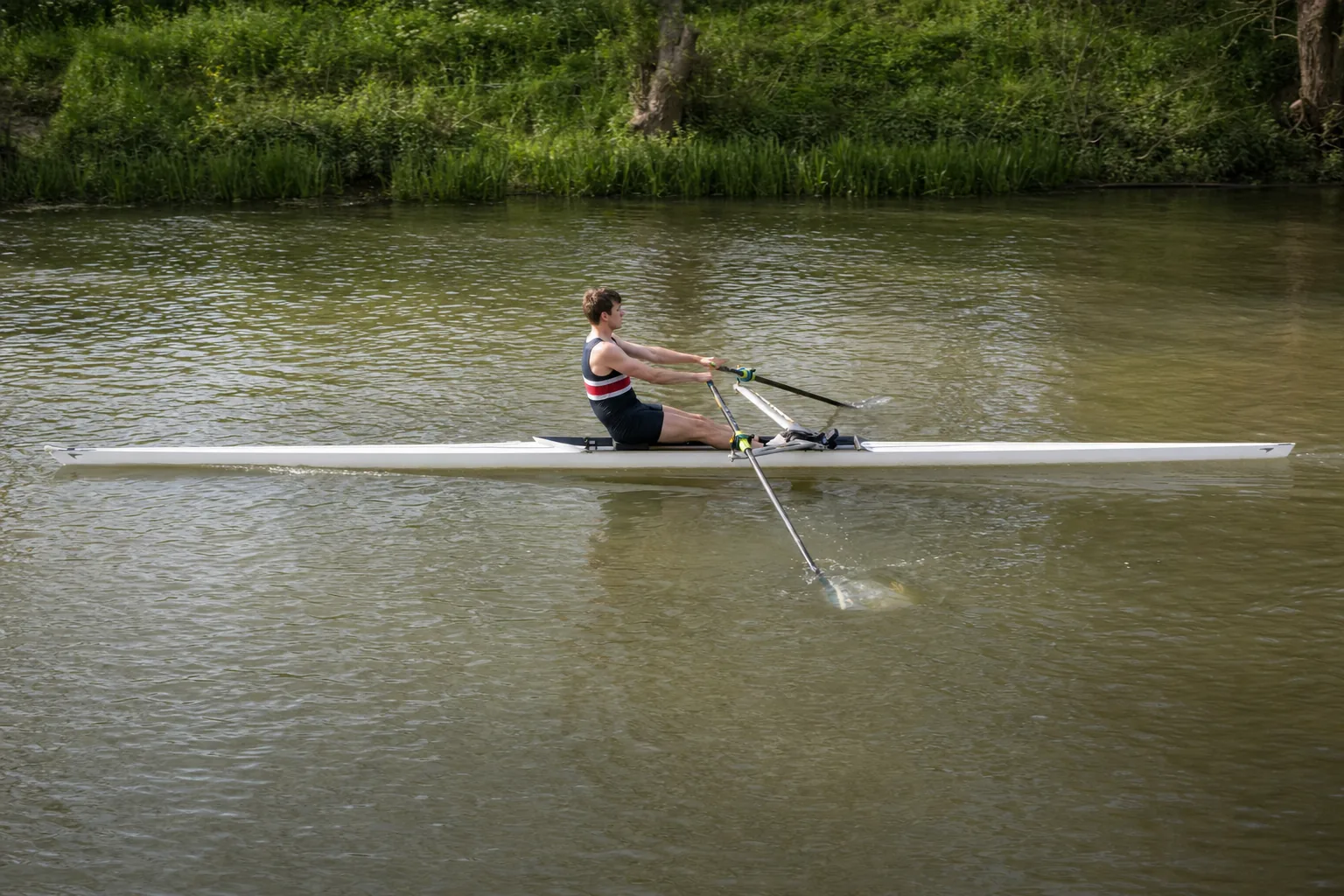
The drive is the propulsive half of the rowing stroke, running from blade entry at the catch to blade exit at the finish. Power is applied in a strict leg-back-arm order, with peak force aimed at the front of the stroke where the blade has the best purchase. The drive produces every meter of boat speed; the rest of the cycle is setup and reset.
Also called: Drive Phase, Power Phase
Definition
The drive is the half of the stroke during which the blade is in the water and the athlete is loading force into the handle. It starts the instant the blade is fully buried at the catch and ends the instant the blade clears the surface at the finish. Force runs from the foot stretcher, up the legs, through a coordinated back swing, out the long arms, and into the handle. The rigger and oarlock convert that force into a lever working against the blade-on-water.
It is the only propulsive phase. The catch is the blade-in moment that triggers it, <a href=":finish_url">the finish</a> is the blade-out moment that ends it, and <a href=":recovery_url">the recovery</a> is the non-propulsive slide forward that sets up the next one. Boat speed is generated here and only here.
The drive sequence
Legs, back, arms. In that order, every time:
- Legs: the quadriceps and glutes drive first against the foot stretcher. The seat moves toward the bow, the handle moves with the seat, and the back stays set forward. The arms stay long.
- Back: as the legs approach full extension, the back swings from forward body angle through vertical and into layback. The hip hinge does the work; the lumbar spine stays braced.
- Arms: only at the end does the elbow break. The arms draw the handle into the body to finish the stroke.
Reversing the sequence is the most common drive fault in any US program, novice through varsity. Pulling early with the arms throws away the lever advantage of straight arms. Opening the back early forces the back and the legs to compete instead of relay. The legs are the largest, strongest muscle group on the rower and the sequence exists to use them first while the smaller muscles finish the job.
Power profile across the drive
A good force curve is front-loaded: maximum force in the first third of the drive, tapering toward the finish. The blade has the best grip at the catch because the shell is slow there and the blade has minimum velocity relative to the water. As the boat picks up speed through the drive, the blade slips more, so a force applied at the finish does less for the boat than the same force applied at the catch.
Instrumented oarlocks make this visible at the squad level. NK EmPower and Active Tools Empirical write a per-stroke force curve to the cox box display, and programs from Washington and Cal down to club programs at Vesper and Penn AC use the trace to spot athletes hauling the back end and to retrain the curve toward the front. A back-loaded force curve looks like a strong rower on the erg flywheel and a slow rower on the water.
Drive to recovery ratio across rate
The drive itself takes roughly the same wall-clock time at every rate, because the legs only have one speed they can extend at full power. What changes with rate is the recovery, which compresses dramatically as the rate climbs. At 20 spm in a long UT2 piece, the recovery runs two to three seconds, the drive runs under a second, and the ratio sits at 1:2 or 1:3.
At 38 spm during the middle 1k of a C.R.A.S.H.-B 2k, the recovery has shrunk to roughly the same length as the drive. Crews that maintain the longest controlled recovery they can at race rate keep more boat run per stroke and post faster splits for the same drive force. The erg pace calculator converts target splits into watt output and stroke counts so a coach can build rate-specific drive force expectations into the practice plan.
Common drive errors
Drive faults compound. Each one robs force at a different point in the curve:
- Shooting the slide: legs straighten before the back engages. The seat moves back without the handle. The number one drive fault in any US novice program.
- Opening the back early: the back swings before the legs are done. The back and legs compete rather than relay, and the front of the curve is hollow.
- Bending the arms early: the elbows break during the leg drive. The straight-arm lever is lost and the back works against a moving fulcrum.
- Back-loaded force curve: the athlete hauls at the finish rather than the catch. Looks strong from the seat, looks slow from the launch.
Drive across the stroke rate band
The drive sequence and force curve stay constant whether the crew is rating 18 spm in a thirty-minute UT2 piece or 40 spm in the middle of the IRA grand final. What changes is everything around it (the recovery length, the catch timing, the cox calls). US programs build rate ladders into the weekly practice mix (5 minutes at 20, 5 at 22, 5 at 24, 5 at 26, 5 at 28) precisely so the drive becomes automatic across the full operational rate range. See <a href=":stroke_rate_url">stroke rate</a> for the per-minute cadence side of this.
Drive FAQs
What is the drive in rowing?
The drive is the half of the rowing stroke that moves the shell. It starts at the catch (blade buried at the front of the slide) and ends at the finish (blade exiting the water at the body). The athlete pushes force through the foot stretcher into the legs, through the back, and out into the handle, which the rigger transmits to the blade against the water. Everything else in the cycle (the catch, the finish, the recovery, the feather and square) is setup. The drive is the only phase that produces propulsion.
What is the drive sequence?
Legs, then back, then arms. The legs do the heaviest work first while the back stays set forward and the arms stay long. The back opens as the legs near full extension, swinging from forward body angle through vertical to layback. The arms break last, drawing the handle into the body to finish the stroke. Reversing this (opening the back early, or pulling with the arms while the legs are still loaded) wastes the strongest muscle group in the body and is the single most coachable fault at the novice and JV level in US college rowing.
When is peak power applied during the drive?
At the front, not the back. The blade has the best purchase on the water at the catch because the shell is moving slowest relative to the water there. Front-loaded power profiles (a tall force curve in the first third of the drive, tapering to the finish) are the model US national team and IRA-grade programs train toward. Back-loaded profiles, where the athlete hauls harder at the body than at the catch, look strong on the erg flywheel but waste blade purchase on the water.
What is the drive-recovery ratio?
The proportion of cycle time spent on the drive versus the recovery. At UT2 steady state (18 to 22 spm) the recovery is two to three times as long as the drive, so the ratio is 1:2 or 1:3. At C.R.A.S.H.-B race pace (36 to 40 spm) the recovery shortens and the ratio runs close to 1:1. A varsity eight that holds a longer recovery at 38 spm than its rivals usually has more boat run per stroke, which shows up as a faster split for the same drive force.
What does shooting the slide mean?
A drive fault where the legs straighten before the back has engaged. The seat slides back without taking the handle with it, so leg power is wasted. From the launch the coach sees the athlete's seat moving faster than the handle, which is the unambiguous tell. It is the most common drive error in US college novice programs and shows up on instrumented oarlocks (NK EmPower, Active Tools Empirical) as a flat or hollow front of the force curve.
Related
What is the Catch in Rowing?
The catch is the single instant in the stroke when the blade enters the water at the front of the slide. The shell is mo...
What is the Finish in Rowing?
The finish is the back-end blade exit, the instant the blade leaves the water at the body and the drive ends. Tap-down t...
What is the Recovery in Rowing?
The recovery is the non-propulsive slide back from the finish to the catch, with the blade out of the water. The boat ke...
What is Stroke Rate?
Stroke rate is the per-minute cadence the cox box, NK SpeedCoach and Concept2 PM5 monitor display, in strokes per minute...
Keep learning
Drive timing changes quickly as a crew moves from steady-state work to race pace. Coaches can keep practice notes and athlete feedback in Row HQ's rowing club software, then use the rowing glossary to connect the drive with the catch and recovery.
One drive force curve per athlete, across the whole season.
NK EmPower and Active Tools spit out per-stroke power data. Row HQ keeps it linked to the right athlete across every practice so the coach can see whether the front of the curve is getting taller, week over week.